Fund Students, Not Sit-Ins
Why the May 1 Teacher Walkout Missed the Mark on Education
Jonathan Bridges
May 5, 2026
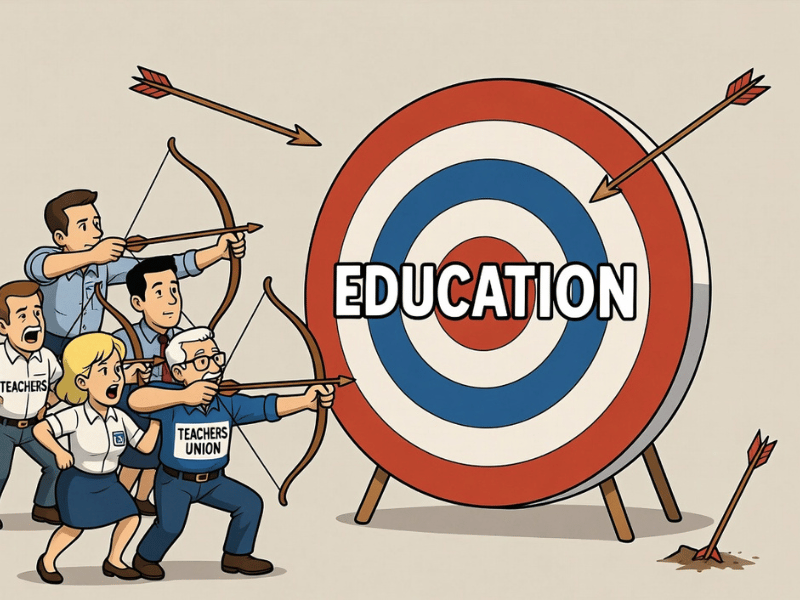
Last Friday, many Wilmington classrooms sat empty as teachers headed to Raleigh. While the headlines focused on educational "funding gaps," the real story is about a refusal to accept the North Carolina Supreme Court’s recent Leandro decision and a desire to push a litany of union-backed policies in our state.
The End of a 32-Year Education Battle
For decades, the Leandro case was used as a judicial workaround to the North Carolina Constitution. The North Carolina Association of Educators (NCAE) and activist groups hoped a judge would force the state to spend billions, bypassing the legislative branch entirely.
This legal saga began in 1994, when five low-wealth school districts and families sued the state over funding. In 1997, the North Carolina Supreme Court affirmed the right to a "sound basic education." By 2004, the Court focused on at-risk students in Hoke County. However, between 2017 and 2023, the trial court expanded its reach, attempting to implement a "Comprehensive Remedial Plan" (the WestEd plan) for the entire state. What began as a challenge regarding specific district needs morphed into a massive, statewide spending mandate.
On April 2, 2026, the N.C. Supreme Court brought the drawn-out battle to a definitive end. In a 4-3 opinion, the Court ruled that the power to tax and spend is an authority vested solely with the General Assembly. The Court dismissed the case with prejudice, affirming that the judiciary is not—and should not be—an expert in education policy.
Chief Justice Newby’s opinion highlighted a critical error in the lower court’s handling: the 1994 lawsuit was an "as-applied" challenge, meant to address specific students in specific counties. Over time, the trial court improperly treated it as a "facial" challenge to the entire state system, despite the plaintiffs never properly amending their pleadings to make such a massive, statewide claim.
Federal Precedent Against Leandro
The N.C. Supreme Court’s decision isn’t a political win; it is a return to bedrock precedent set by the U.S. Supreme Court over 50 years ago in San Antonio Independent School District v. Rodriguez (1973).
In Rodriguez, the U.S. Supreme Court ruled that education is not a fundamental right under the U.S. Constitution and warned that judges lack the "specialized knowledge and experience" to oversee local tax systems and school budgets. The Court upheld that the San Antonio Independent School District's financing system- based on local property taxes- was not a violation of the Fourteenth Amendment's equal protection clause. The 2026 NC decision mirrors this logic: judges are not school board members, and they certainly aren't tax collectors. As Justice Powell noted then, and as our state court affirms now, “The heavy lift of education reform belongs to those who answer to the taxpayers, not those who wear black robes.”
Furthermore, in the 2009 case Horne v. Flores, the U.S. Supreme Court criticized lower courts for maintaining school-funding injunctions long after original conditions had changed. Justice Alito emphasized that courts must be "sensitive to the state’s interest" in managing its own institutions. NC’s economy and school system have been transformed since 1994; Horne provided the legal framework for our courts to finally step back and let elected leaders drive policy.
The NCAE’s Socialist Laundry List
The activists who protested in Raleigh claim their walkout was "for the children." In reality, they are protesting the Constitution and pushing a radical agenda that would strip power from parents and hand it to unions like the NCAE.
The NCAE’s platform goes far beyond the classroom. They are seeking to bypass constitutional legislative authority in favor of their own political interests. Consider their socialist laundry list, which seeks to throw taxpayer money at the wall without regard for local district needs:
- Massive Spending: Demanding \$20,000 per student by 2030 and a 25% across-the-board raise for all employees, regardless of performance or local tax base.
- Economic Hostility: Eliminating corporate tax incentives that bring jobs to NC, ending Opportunity Scholarships for families, and "fixing" the tax system—a smoke screen for massive tax hikes.
- Political Power Grabs: Forcing a lift on the ban on collective bargaining for public workers and demanding "fair maps" to benefit their preferred candidates.
These blanket policies would bankrupt school districts, tank our state’s economy, and end North Carolina’s status as a top state for business.
Conclusion: Funding Students, Not Politics
We all want our students to have access to a high-quality education. To suggest that the General Assembly doesn't want to fund schools is disingenuous. The legislature is currently advocating for sustainable teacher raises, fighting for parental rights, and providing students with the choice to attend schools that best fit their needs.
While the legislature works on a transparent education budget, radicals want funding decisions made behind closed doors by unelected union leaders and judges. We see this local radicalism in New Hanover County as well, where board members like Judy Justice have encouraged teachers to be political and walk out on their students.
The framers of our state knew that funding and budget decisions are best made by elected leaders, and it is time to fund students, not union-backed sit-ins.
Download Article
 Jonathan Bridges is a political strategist specializing in fundraising for Republican Congressional and gubernatorial campaigns nationwide. He has spent over a decade serving as a general consultant and campaign manager, and has worked in the nonprofit sector.
More From Between Two Bridges
Jonathan Bridges is a political strategist specializing in fundraising for Republican Congressional and gubernatorial campaigns nationwide. He has spent over a decade serving as a general consultant and campaign manager, and has worked in the nonprofit sector.