Leadership: Goodness or Corruption
Many around the world are giving a sigh of relief. But, what does the future hold?
Mark Sooy
March 26, 2025
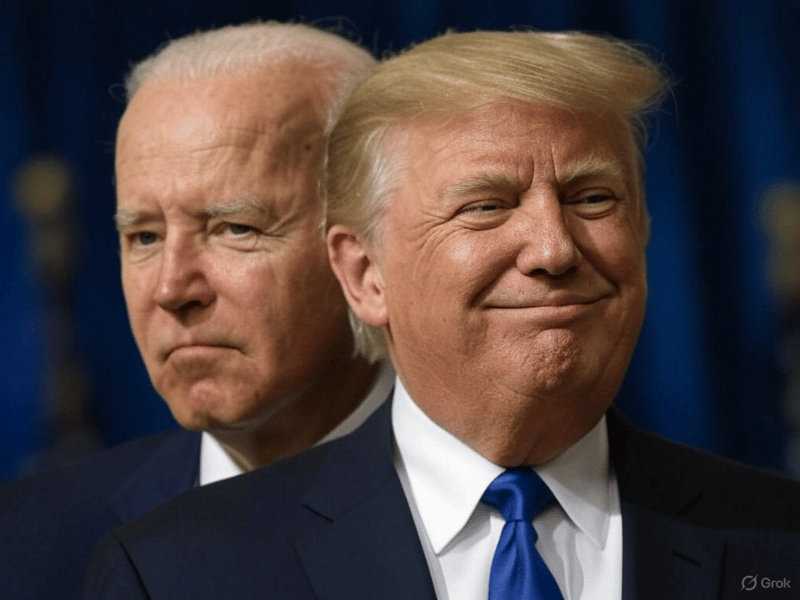 The American people, and the world if they choose to notice, are being presented with a lesson in the stark differences between leaders based on the motivation and direction of their leadership. There is an interesting biblical principle that demonstrates these differences and it is encapsulated in the following verse:
When the righteous increase, the people rejoice,
But when a wicked man rules, people groan.
-Proverbs 29:2 NASB
While there is no doubt there may be historical examples that demonstrate the truth of this principle, we need to look no further than the stark differences between the Biden administration and the Trump administration. There is mounting evidence that Biden’s leadership led to “groaning” due to economic malfeasance, open borders, and other misguided policies. By way of comparison, Trump’s leadership is leading to much “rejoicing” as consumers are seeing relief in prices, illegal alien criminals are being rounded up and taken off the streets, and other policies have promising forecasts for the future.
An important element for us to remember is that the United States leads the world in many ways, and we find that many countries and people around the world will also “groan” or “rejoice.” Just as the United States sows corruption within its own borders, it also sows corruption throughout the entire world. Conversely, as the United States sows goodness within it own borders, it also sows goodness throughout the entire world.
The Kings of Israel
The history of the Kings of Israel (and Judah) is another place we can turn to see how this principle of leading in corruption or goodness affects a nation.
King Manasseh easily ranks as one of most corrupt and evil kings in Israel’s history (2 Kings 21). Interestingly, he was the son of Hezekiah who was a good king overall (18:3-6), though not always very wise (18:14) even though he finally trusted the Lord for deliverance (19:15-19). Despite the generally good rule of Hezekiah, his son Manasseh turned to evil and under his leadership he “seduced them [Israel] to do evil more than the nations whom the Lord had destroyed” (21:9). The inevitable path of Manasseh’s leadership crystallized the pattern of disobedience within the nation resulting in a pronouncement of grim calamity against the whole nation, even the remnant of the faithful (21:11-15). The ultimate end of Manasseh’s reign was “when a wicked man rules, people groan” (Prov. 29:2).
Just a couple years later, King Josiah ascended to the throne. Josiah was Manasseh’s grandson, but unlike his grandfather (and father) he was considered the best of Kings, second only to David himself (see 2 Kings 22:1 – 23:30 for the whole story). Josiah began to rebuild the temple because it had been desecrated (22:3-7). In the temple his workers found the book of the law, which had been lost, and Josiah discovered that Israel was under serious judgment (22:8-20). Josiah had the book of the law read to the people and they began to follow it fully (23:1-3). This led to many reforms (23:4-20), and, ultimately, to a celebration which had not been seen for centuries (23:21-23)! Josiah was great king and reformer, and the goodness he promoted was a benefit to all the people which led to rejoicing. “Before him there was no king like him who turned to the Lord with all his heart and with all his soul and with all his might, according to all the law of Moses; nor did any like him arise after him” (2 Kings 23:25).
However, while Josiah’s reforms were a great recovery for Judah, God declared that judgment was still in store (23:26-27). It seems that God was giving them a bit of a reprieve before the hammer fell.
Parallels
By making these observations, I am not suggesting that Biden and Trump are direct parallels with Manasseh and Josiah. What I am suggesting is that the principles which are noted in the stories of those two Kings are evident in the stories of these two Presidents. Corruption really does lead to groaning, and promoting goodness does lead to celebration. In the case of our interconnected global world, the ripples seem to touch every corner of the earth.
We seem to be in a bit of reprieve, or at least the beginnings of one. Many in the United States, and around the world, are breathing a sigh of relief. Hope is rising in reality, and not just in words. The future is looking brighter. All is not lost. We can be grateful.
There still remains a question which seems to me to be complex. This is difficult to answer and clearly dependent on God’s mercy: As we experience a reprieve from corruption and celebrate goodness in our culture today, what lies in store for the future in regard to judgment?
I am not sure, but while goodness spreads – let’s rejoice!

Mark Sooy is a theologian, teacher, author, and musician who serves in university instruction, authoring, conference speaking and leading, private music instruction and other forms of Christian service. Mark holds a Doctor of Ministry degree from LBC | Capital Seminary with a focus on the spiritual formation of leaders, an MA in Historical Theology from Grand Rapids Theological Seminary of Cornerstone University , and a Bachelor of Theology degree from Grace Bible College. He is also a commissioned graduate of the Colson Fellows (formerly known as the Centurions Program ).
Mark’s published work includes articles for periodical publications, devotionals, as well as three books: Essays on Martin Luther’s Theology of Music ; The Life of Worship: Rethink, Reform, Renew ; and, Lessons in the Silence of God.
A fourth book, co-authored with Elisabeth Sooy, is titled: Weekday Wisdom: Daily Reflections for Leaders and Administrators
Mark and his wife currently reside in West Michigan. For further information please visit: www.MarkSooy.com
