
Movie Review: The Life of Chuck
39 great years! Thanks Chuck!
Colin Fels
June 20, 2025
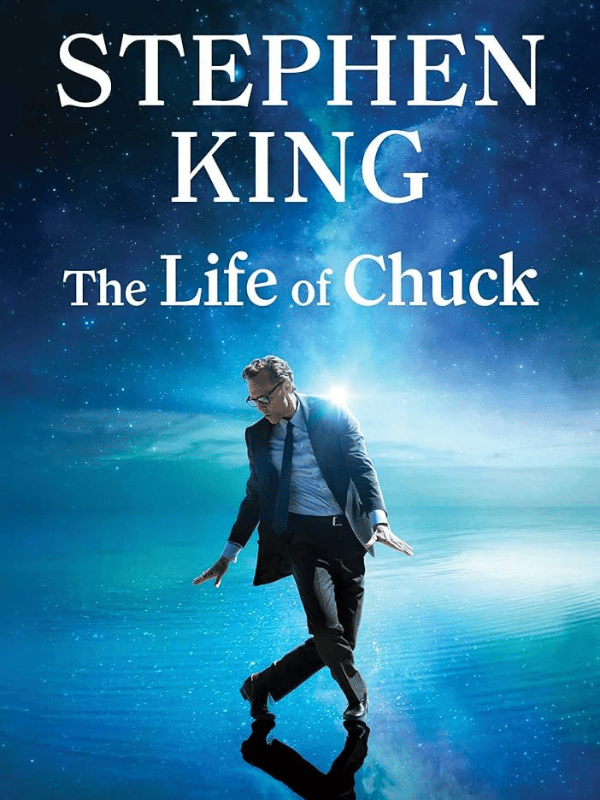 The introduction of this cryptic reference cycles through your imagination during the opening scenes of director Mike Flanagan's newest film, The Life of Chuck. This would be Mike Flanagan's first film that isn't necessarily within the popular horror genre. The Life of Chuck sets the stage briefly with some horrific themes, but manages to mostly stray away from the scares.
What may really subvert your expectations, is that this 2025 film is based on a Stephen King short story. It's common knowledge that we all know Stephen King as the actual "King" of horror itself. So when I heard his newest adapted work was centered around life affirming story-telling at its core, I knew I needed to get to a theater quickly to see for myself. Flanagan is no stranger to the prolific works of King. Naturally, his directorial style complements King's tone after two other projects have already been released based on the master of horror's old and new written material. Both releases Gerald's Game (2017), and Doctor Sleep (2019) were picked up by Netflix, both originally novels by Stephen King, both helmed by director Flanagan.
2018 saw the Netflix release of The Haunting of Hill House, which placed Flanagan on solid ground as a major influential force for fans of terror. The series would receive critical acclaim and spur Mike Flanagan to produce and direct several scarier projects since that time, an overwhelming amount of them picked up by, you guessed it, Netflix.
The Life of Chuck delivers a fresh storyline told in reverse order. During the opening scene, high school teacher Marty Anderson is the first character the film introduces, as he and others around him struggle to make sense of a world that is enduring a wide expanse of catastrophes. From wildfires to tectonic shifts and flooding, the world is evidently headed towards disorder and destruction. There are countless businesses closing, people in absolute despair, and indicators of a failing world around every bend. Internet and electrical outages soon ravage large cities and suburban streets. Long-time teacher Marty Anderson, out of familial longing seeks shelter with his ex-wife Felicia Gordon who's a nurse at the local hospital. The ex-lovers draw near as cosmic forces in the night sky emit flashes and sounds of decay, destruction, and a nearing apocalypse. After all, this wouldn't be a Stephen King story without just a few events that signal the impending urgency of doom and gloom.
As the story travels backwards in time suggesting how events are to unfold, we're introduced to the main character played by Tom Hiddleston. Meet Chuck, a late-thirties man and successful accountant who happens to be momentarily breaking away from a recent banking conference in Boston. He makes his way through a leisurely crowd of outlet shoppers and families, coming upon a street busker named Taylor. The Juilliard drop-out has a drum kit set out in the shopping square, her tip hat upright on the ground, mechanically driving a steady percussion for the momentary passerby. Only one person out of this crowd stops to give Taylor their attention, and that's Chuck Krantz.
There is something really charming during this act of the film. Actor Tom Hiddleston devotes his time and effort working with choreographers to perform a really cool dance number. His dancing comes across as fluid, and in-tune to the style of play accompanied by the percussion. Chuck dances to Taylor's rhythmic change-ups as the two feed off one another. Two complete strangers, yet magic is being created, and a crowd is gathering. Chuck then pulls a recently dumped and heartbroken woman into the dance circle, her name is Janice Halliday. Both she and Chuck groove with the rhythms and move as a duo, as the tip-hat begins to soon collect.
As a singular character study, you get a sense of Chuck's influence on others at this point. Where he goes, meaning and joy are shared with soon-to-be friends and acquaintances. But, nothing lasts forever. Time is finite when it comes to a natural lifetime. Sickness and well-being become common alongside a greater overall theme of the story.
We're taken further into the earlier life of our protagonist, and Chuck is reintroduced to us from events during his childhood. His father and pregnant mother are taken from him in a tragic car accident. Chuck is then raised by his paternal grandparents, Albie and Sarah. The grandparents dutifully pour their love and devotion into young Chuck amidst years of grief surrounding the loss of the parents. In time and after seasons of healing, Sarah begins to teach Chuck to dance in different forms and styles. They share a love of music and dance while cooking meals in their home kitchen, and Chuck receives his very own lessons in dance from his grandmother Sarah.
Amidst the often lighter parts of the movie, there are some darker corners of the grandparents' history that would remain untold.
There is one haunting secret about Albie and Sarah's house, and that is the locked room. Albie would warn Chuck to never open the door to that closed-off space of the house. Naturally, Chuck questions the secret room. There has long been a deadlock to this mysterious area located within the top cupola of the home. The keys to the room have always remained in Albie's possession.
Though he remains mostly attuned to caring for Chuck, Albie is an alcoholic. The grandfather ends up recollecting more than he planned to about the secret room after Chuck questions him during a night of drunken stupor. Albie drums up an excuse on the spot by saying that the floors up there are not secure. But more frighteningly, Albie would claim to have seen ghosts of people who had died. The ghosts were of people known to him or friends within the community. Once again, the grandfather implores Chuck to not go exploring.
As Chuck matures and grows in age, he makes new friends and shares his love of dance with friends along the way. There is something special as we witness the world pouring universal truths into his younger version. One teacher would even endearingly cup his head between her hands, expressing encouragement and claiming that Chuck contains multitudes, a sentiment expressed from their recent class study of Walt Whitman's work. The meaning behind this is that Chuck's just a human being, but destined for a multi-faceted life whereby holding diverse thoughts and feelings within the vast world of his mind.
There is a deeper meaning to be derived from this film, and it's meant to be our pleasure as an audience, to piece together a larger portrait which comes into focus along the way. As we follow Chuck and his life in reverse order, we continue forward through a current of grand storytelling, sweeping us through the ebs and flows of a life lived with intention.
There is a real aspect of heartfelt intimacy to director Mike Flanagan's deft pacing and careful approach. As we follow the story and its characters, there is seemingly a beautiful world of cosmic wonder that comes from a shared purpose in relationships and in life. In a time where we're barraged by waves of information and sometimes counterfeit forms of human connection, this movie may produce a shift in your heart and soul. You might feel grounded and delighted, as you witness many small decisions that add up to a life well-lived.
The characters are a major attraction for this film, each have some sort of truthful revelation or epiphany to be addressed and shared with one another. The messages you take away are abundantly human, and should give you enough reason to stay glued to the seat until the credits roll.
Download Article
 Colin Fels currently resides here in Wilmington, NC and is one of the contributing writers for The Wilmington Conservative. Colin holds a BS in Communication Studies from The University of North Carolina Wilmington. Colin has a love for music, film, writing, and digital marketing. You may catch him playing around Wilmington, Leland, Shallote, & Oak Island in his band Miles Atlas.