
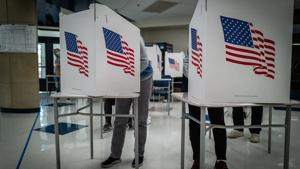
(The Center Square) – More than 1.1 million ballots have been cast in the midterm election by North Carolinians, an update Thursday from the State Board of Elections says.
Ballots in the nation’s longest voting window, 61 days beginning with mailed ballots on Sept. 4, include 42,996 civilians by mail, 1,111 military by mail, and 6,989 overseas by mail. Early in-person voting started on Thursday of last week and thus far includes 1,050,225 ballots.
Ballots have arrived from as far away as Kangaroo Point in Australia and Ross Island in Antartica, where McMurdo Station is the largest American research base on the continent.
The early in-person period ends Oct. 31. Election Day is Nov. 3, with polls closing and all absentee ballots by mail due to county elections offices by 7:30 p.m.
Dr. Michael Bitzer, a periodic source to The Center Square from the Center for North Carolina Politics & Public Service at Catawba College in Salisbury, in a substack Thursday wrote in part, “There’s a lot of ways to analyze this data, but the remarkable dynamics beyond the fact that we are half-way to 2022’s total numbers, and still have 10 more days to go, is something that will make 2026 one for the record books in terms of North Carolina’s midterm elections.”
The last cycle of midterms in 2022 was coming off the COVID-19 era. The total ballots at the same time before Election Day numbered 798,778, with 724,422 of them early in-person voting.
By voter registration, Democrats (20.3%) have cast the most ballots thus far. The unaffiliated bloc is next at 11.9%, and Republicans are third at 10.7%. The state’s more than 7.8 million voter registrations breaks down to 40.2% unaffiliated (3.1 million), 29.6% Democrats (2.3 million) and 29.5% Republicans (2.3 million).
Within the demographics, more than 63% of the total voter registrations are whites and 19.3% are Blacks. Within the ballots cast thus far, nearly 67% are whites and 22.4% are by Blacks.
Voters will choose a U.S. senator, all 14 members of the U.S. House, and all 170 members of the General Assembly. One state Supreme Court seat and a number of judges, district attorneys, and county level offices are on the state's second-longest ballot of the four-year cycles.
Three constitutional amendments are also on the ballot.
Earlier this week, first-term Democratic Gov. Josh Stein drew attention by writing on social media “thousands more absentee ballots being rejected this election – at a rate twice as high as 2022. It’s infuriating.”
The State Board of Elections confirmed to WUNC the rate in 2022 was 2.6% and in 2026 is 3.1%. Veteran politicos in the state say two to three per 100 is the historical norm.
Content Original Link:
https://www.thecentersquare.com/north_carolina/article_cc840e9b-953c-443a-ad22-1270780fe4c8.html?a