
250 Years of Islamic Piracy Returns
From Tripoli’s Barbary Coast to the Strait of Hormuz, The Same Enemy, The Same Test of American Resolve
Sam Ibraham
April 20, 2026
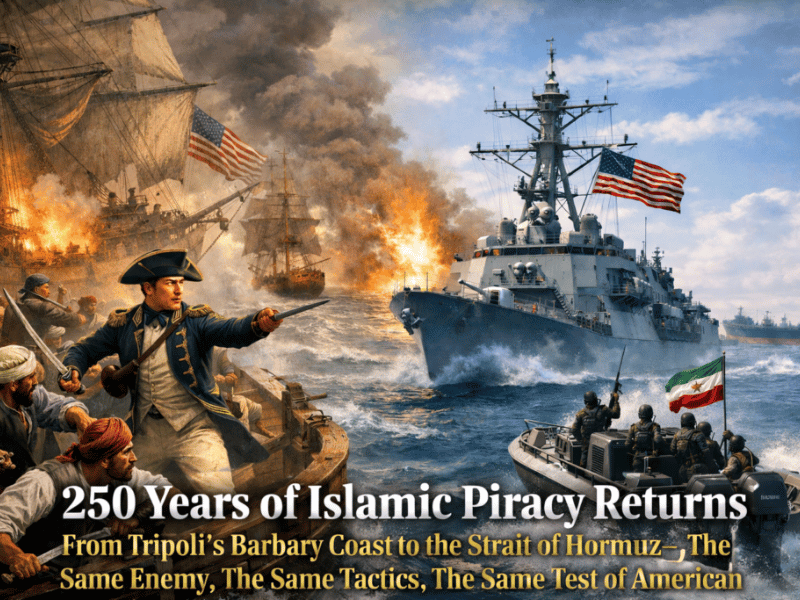 As America approaches the 250th anniversary of its independence, a reality emerges from the pages of history: the nation is once again confronted by a familiar adversarial conflict.
Two and a half centuries ago, the young United States faced a ruthless threat on the high seas; the Barbary Coast piracy. These were not isolated criminals, but state-backed actors who seized American ships, enslaved American sailors, and tested the resolve of a newly independent nation. Sailors were taken in chains, transported across the Mediterranean, and sold into bondage. Some were forced into hard labor, rowers in galleys, laborers in quarries, or servants in harsh and degrading conditions. Others were held in captivity for years, their freedom contingent upon ransom payments negotiated from across the ocean. This was not random criminality.
This was organized, state-sanctioned Islamic piracy, a system of maritime extortion directed primarily at the Christian West. Their actions were not rogue operations but a recognized instrument of state power, carried out within a broader Islamic imperial sphere linked to the Ottoman Empire.
At that critical moment, America learned a hard and enduring lesson: independence without strength invites predation.
European powers, for centuries dealt with this Islamic piracy with endurance to the pressure, paying tribute, negotiating temporary protections, and tolerating a structure in which commerce was held hostage. The legacy of earlier civilizational conflicts between Christian Europe and Islamic powers, stretching back to the era of the Crusades, remained part of the historical consciousness. Whether driven by memory, opportunism, religious hatred, or economic incentive, the Islamic Barbary regimes leveraged this dynamic into a predictable and institutionalized system of coercion: pay, or be preyed upon. European powers chose appeasement and accommodation over resistance, they treated the problem as something to be managed rather than eliminated.
Once the United States secured its independence, the Kingdom of Great Britain made clear to the Barbary regimes that American ships no longer fell under British protection. Britain effectively exposed American commerce to immediate exploitation, signaling to the very powers engaged in extortion that a new, unprotected target had entered the waters.
In 1794, after the Islamic Barbary pirates seizures of American ships, congress authorized construction of the first six ships of the U.S. Navy. Naval History connect the rise of Barbary piracy and the attacks on American freedom of navigation to the Naval Act and the birth of the permanent Navy.
The creation and deployment of the United States Navy marked a turning point. No longer dependent on diplomacy alone, America projected force into the Mediterranean, directly challenging the Barbary regimes on their own waters. During the First Barbary War, American naval forces engaged Tripoli in a sustained campaign that demonstrated both resolve and capability. This was followed by a more decisive assertion of power in the Second Barbary War, when American forces struck Algiers and imposed terms that ended the practice of tribute and secured the release of American captives. The message was unmistakable. America would not pay for its right to exist on the seas. It would enforce it.
Today, as we stand on the threshold of that 250-year milestone, we face a strikingly similar challenge. The Islamic regime in Iran has turned vital waterways into arenas of coercion, harassing, seizing, and threatening international shipping in ways that echo the very tactics employed by the Islamic Barbary powers centuries ago.
Then, as now, America encounters not only a hostile force, but the uncomfortable reality of so-called allies whose support proves uncertain when tested. Then, as now, the burden of securing freedom of navigation, and defending national sovereignty, falls disproportionately on the United States.
Today, in the waters surrounding the Strait of Hormuz, the United States confronts a hostile force disrupting maritime security. And once again, the response from many European nations reflects hesitation, indifference, or selective engagement. Statements are issued. Concerns are voiced. But decisive, unified action often remains elusive. Allies in principle are not always allies in practice. And when the test comes, nations discover who will stand, and who will step back. History is not repeating itself by accident. It is reminding us of something we would prefer to forget.
Appeasement sustains aggression. Delay invites escalation. Weakness is exploited. Two hundred and fifty years ago, America stood mostly alone against piracy and ended it. Today, as others issue statements and measure risks, the United States is once again called to bear the weight of action. Not because it seeks conflict, but because it understands what others refuse to accept: peace without strength is an illusion. The question is no longer whether the threat exists. The question is whether America will once again finish what it started.
The enemy has not fundamentally changed.
The methods have not fundamentally changed.
And too often, neither has the reliability of those who claim to stand beside us.
Download Article
 Samuel Ibrahim is a follower of Jesus Christ and a grateful immigrant who grew up in the Middle East before finding freedom and opportunity in the United States. A husband of 38 years, father of four, and grandfather of three, he built a four-decade career in technology and business, including founding and successfully selling a software company. His love for America is rooted not in sentiment but in lived experience: he knows firsthand what it means to leave repression and embrace liberty.
Samuel writes not from academic theory or professional title, but from conviction. His analytical approach, shaped by years of problem-solving in business and technology, informs a clear and sober assessment of America’s cultural and spiritual decline. His journey—from a region marked by authoritarianism to a nation founded on biblical truth and ordered liberty—gives him both perspective and responsibility.
More From Sam Ibraham
America: Reflections of a Grateful Immigrant on America's 250th Anniversary
- Wednesday, 20 May 2026 13:23
 Grateful immigrant Sam Ibraham reflects on faith, freedom, and America’s self‑correcting promise at our nation’s 250th anniversary.
All Diests? Hardly.
- Monday, 11 May 2026 15:59
 Debunking the myth: Were all Founding Fathers deists? Sam Ibraham exposes leftist distortions of history, Jefferson's words, & Christian quotes from Washington, Adams. True story of America's...
If Christianity Were A Song
- Wednesday, 06 May 2026 09:06
 Is modern Christianity a soothing lullaby or a battle hymn of truth, courage, and action? Discover the true call of biblical faith in this powerful article.