
The Nehemiah Way
American Restoration That Leads to Revival
Sam Ibraham
May 1, 2026
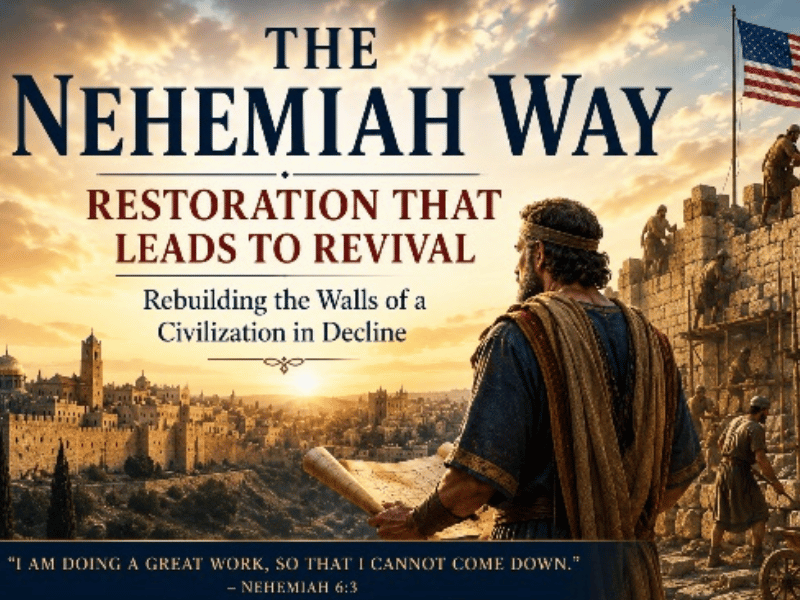
There is a common refrain heard across America, particularly in Christian communities and patriotic circles: what America needs is a revival. A spiritual awakening. A return to the values and principles that made this nation the most extraordinary civilization in human history. Most who call for revival believe that renewal of the spirit is the necessary prerequisite to any meaningful restoration of society.
But what if there were a different way?
Biblical Foundation
The book of Nehemiah, written more than 2,500 years ago, is not merely an ancient historical account. It is a blueprint for civilizational restoration. It tells the story of a broken people living among the ruins of a once-great nation whose walls had been destroyed and whose gates had been burned with fire.
Nehemiah was living as a captive in the Persian Empire, serving as a cupbearer to King Artaxerxes, when he received devastating news from his homeland: the walls of Jerusalem were broken down and its gates burned with fire. His response was immediate, he wept, prayed, fasted, and mourned for days.
Why such grief over stone and mortar?
Because the walls and gates of Jerusalem were never merely physical structures. They represented the safety, security, and moral integrity of an entire people. Functioning walls kept foreign invaders out. More importantly, they kept foreign ideologies, false gods, and corrupting influences at bay. Walls symbolized security, order, protection, and identity. Without walls, a city became vulnerable to invasion, corruption, and eventual destruction. The gates controlled what entered and exited the city. Once destroyed, foreign influences flooded in unchecked.
The parallel to modern America is impossible to ignore. This nation was not conquered by a foreign military. It was not overtaken by force. Instead, the metaphorical walls, the Judeo-Christian principles and founding values that once defined and protected American identity, were quietly dismantled from within. And once those walls came down, the flood followed: destructive ideologies, moral confusion, and a cultural drift so severe that many Americans no longer recognize the country they grew up in.
Diagnosing America’s Condition
America’s cultural and moral walls have also been torn down. The gates that once protected truth, faith, morality, family, and national identity have been deliberately dismantled. The result has been ideological invasion. Not through foreign armies, but through destructive ideas that have slowly eroded the foundations of the civilization itself.
The result, is confusion. Confusion that now permeates every dimension of American life, from politics and economics to sexuality and religion. Socialism, radical progressivism, and ideologies utterly foreign to the American founding have poured through the breached gates. A nation that once stood on the bedrock of self-evident truths now struggles to define the most basic realities of human existence. Men no longer know what a man is. Women are told motherhood is oppression. Children are indoctrinated before they can reason. Churches fear the culture more than they fear God. Patriotism is mocked. Moral clarity is condemned as extremism. And increasingly, America resembles a civilization suffering from spiritual amnesia.
Nehemiah’s story teaches that restoration begins when people are willing to acknowledge the ruin honestly.
What did Nehemiah do in the face of such devastation? He didn’t wait for a revival. He didn’t form a committee, convene a study group, or spend years analyzing the problem. He prayed, and then he immediately acted. His story yields timeless lessons for anyone committed to rebuilding what has been lost.
Lessons from Nehemiah’s leadership
- Seek God first. Nehemiah’s first move was not political or strategic, it was spiritual. He confessed the failures of his people, acknowledged that their own disobedience had brought about their vulnerability, and asked God for guidance before taking a single step. Humility before action is not weakness; it is wisdom.
- Prayer without action is incomplete. For decades, Americans have prayed for healing and revival. Yet conditions have continued to deteriorate. Nehemiah’s example offers a sobering insight: every prayer he lifted to God was immediately followed by decisive, courageous action. God works through people who move. Prayer and action are not alternatives — they are partners.
- Courage is not fearlessness — it is acting despite fear. When Nehemiah stood before the most powerful king in the region to make his request, he was terrified. He acted anyway. That willingness to move through fear, trusting that God was with him, opened doors that no amount of waiting could have unlocked.
- Act immediately, without excuses. Nehemiah did not wait for perfect conditions. He did not stall for more information or broader consensus. When the burden was clear, he moved. Leaders who wait for the ideal moment often find that it never arrives. The work of restoration belongs to those willing to take the first imperfect step.
- A small nudge can ignite great action. When Nehemiah gathered Jerusalem’s leaders, his message was not a lengthy theological treatise. It was direct: We are in trouble. Let’s fix it. That was enough. People often need only a clear-eyed assessment of reality and a simple invitation to act. Don’t underestimate the power of plain truth spoken with conviction.
- Expect opposition — and ignore it. The moment the rebuilding began, the enemies of Jerusalem mocked the effort and leveled false accusations against the builders. Today’s restorers face the same playbook: ridicule, misrepresentation, and charges of extremism or rebellion. Nehemiah’s response was instructive, he acknowledged the opposition and returned to work. The antidote to mockery is progress.
- Challenges escalate before victory. As the walls rose, the opposition intensified. What began as scorn became organized threats. Internal discouragement set in among the builders themselves. Nehemiah addressed both fronts, equipping workers to defend themselves while reminding them of the greatness of the cause. Anyone engaged in restoration work should expect this pattern: the closer you get to completion, the fiercer the resistance.
- Leadership means inspiring, not just directing. Nehemiah’s greatness as a leader was not merely organizational. When his people grew weary and afraid, he rallied them with a reminder of what was truly at stake, their families, their homes, their future. Great leaders connect daily labor to enduring purpose. They lift eyes from the rubble to the vision.
- Confront wrongdoing — even from within. Midway through the rebuilding, Nehemiah discovered that wealthy nobles were exploiting their own people, crushing them under debt while the walls were being raised. He confronted them publicly and demanded restitution. A leader who ignores internal corruption for the sake of unity achieves neither. Justice within the ranks is not a distraction from the mission, it is part of the mission.
- Servant leadership is not a slogan — it is a sacrifice. As governor, Nehemiah held enormous power. He used none of it for personal gain. He worked alongside the builders, refused to tax the people for his own comfort, and devoted himself entirely to the mission for over two decades. This kind of selfless leadership is what earns the loyalty and trust that makes great movements possible.
- Stay resolute against the enemy’s distractions. As the walls neared completion, the opposition changed tactics. Instead of threats, they sent invitations, repeated requests for Nehemiah to leave the work and come meet with them. He refused every time. His answer is worth memorizing: “I am doing a great work, so that I cannot come down.” Distraction is one of the enemy’s most effective weapons. The antidote is a clear sense of mission and the discipline to stay on task.
- Courage is non-negotiable. When the enemy tried to use Nehemiah’s own allies to frighten him into hiding, he refused. A leader who retreats out of self-preservation loses the confidence of those who follow. Courage, real courage, exercised in the presence of genuine danger — is what separates those who finish the work from those who abandon it.
Here is the most powerful and counterintuitive conclusion: when the walls of Jerusalem were finally restored, the gates hung, and the city secured, something remarkable happened.
The people didn’t become comfortable and complacent. They became hungry. They gathered in the public square and asked Ezra the priest to read them the Law of God. They wept when they heard it. A revival broke out as their hearts turned back God and to the principles they had abandoned.
Restoration did not follow revival. Revival followed restoration.
The physical rebuilding, the practical, unglamorous, dangerous work of putting things back in order, created the conditions for spiritual awakening. The people’s renewed sense of safety, dignity, and identity opened their hearts in a way that years of captivity and shame had closed.
Restoration and Revival
This is the message for America today. We cannot simply pray and wait for revival to descend and fix things for us. We must be the builders. We must identify the broken gates, the institutions, the laws, the cultural norms, the educational systems, and do the hard work of rebuilding them, one stone at a time.
The world is not, at its core, complicated. There are those who are working to preserve and restore Christian civilization and the American founding, and there are those who seek its destruction. There is no neutral ground, and there is no more time for delay.
The Nehemiah Way is not a religious program. It is a blueprint for any person of conviction, any vigilant American, willing to stand up, speak plainly, act decisively, and rebuild what has been torn down.
The work is urgent. The hour is late. And as Nehemiah himself proved, all it takes to begin is one person with a burden, a prayer, and the courage to act.
The time to act is now.
This article is adapted from “The Vigilant Americans: Restore and Preserve the Western Civilization and the American Way of Life.”
Download Article
 Samuel Ibrahim is a follower of Jesus Christ and a grateful immigrant who grew up in the Middle East before finding freedom and opportunity in the United States. A husband of 38 years, father of four, and grandfather of three, he built a four-decade career in technology and business, including founding and successfully selling a software company. His love for America is rooted not in sentiment but in lived experience: he knows firsthand what it means to leave repression and embrace liberty.
Samuel writes not from academic theory or professional title, but from conviction. His analytical approach, shaped by years of problem-solving in business and technology, informs a clear and sober assessment of America’s cultural and spiritual decline. His journey—from a region marked by authoritarianism to a nation founded on biblical truth and ordered liberty—gives him both perspective and responsibility.
More From Sam Ibraham
America: Reflections of a Grateful Immigrant on America's 250th Anniversary
- Wednesday, 20 May 2026 13:23
 Grateful immigrant Sam Ibraham reflects on faith, freedom, and America’s self‑correcting promise at our nation’s 250th anniversary.
All Diests? Hardly.
- Monday, 11 May 2026 15:59
 Debunking the myth: Were all Founding Fathers deists? Sam Ibraham exposes leftist distortions of history, Jefferson's words, & Christian quotes from Washington, Adams. True story of America's...
If Christianity Were A Song
- Wednesday, 06 May 2026 09:06
 Is modern Christianity a soothing lullaby or a battle hymn of truth, courage, and action? Discover the true call of biblical faith in this powerful article.