
Builder Versus Critic
What are We Supposed to Build Now?
Episode 46
July 9, 2026
Watch The Reagan Faulkner Show on YouTube
Listen on Buzzsprout
Like and Subscribe


On Page Navigation
Show Notes
Episode Summary
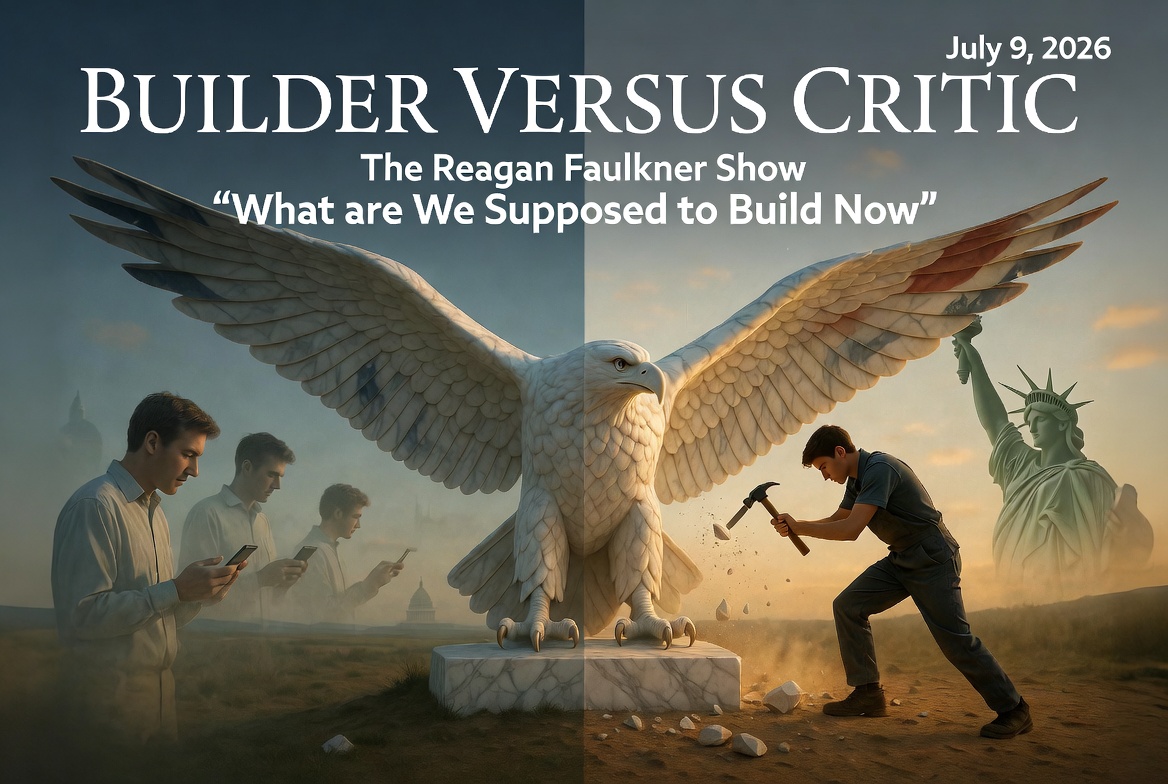
Builder Versus Critic – What are We Supposed to Build Now is a long‑form, summer conversation about why America doesn’t just have an information or commentary problem, but a formation shortage. Reagan Faulkner walks through how engagement‑driven algorithms reward hot takes and doomscrolling while starving the slow, boring work of actually building trustworthy people and institutions. Drawing from American history, from Theodore Roosevelt to Ronald Reagan, she makes the case that criticism feels powerful because it is instant, but builders are the ones who actually shape the future. This episode is an invitation for Gen Z, Gen Alpha, and anyone listening to pick up the “chisel” in front of them—family, church, school, local community—and leave at least one institution stronger than they found it.
What you’ll learn / Key moments
- 00:07 – America is “unfinished,” not broken, and every generation is handed a chisel and a block of marble instead of a completed statue.
- 02:29 – Why the internet rewards the critic with instant dopamine while builders get almost no credit online.
- 05:06 – From “information problem” and “commentary problem” to a “formation shortage” and what formation actually means in real life.
- 10:31 – How honest criticism is a form of stewardship, and where it crosses the line into an identity that replaces actual work.
- 13:10 – Why our algorithm‑driven media ecosystem is literally built to make the critic win and the builder disappear.
- 21:50 – The “man in the arena” passage from Theodore Roosevelt and how it reframes the difference between spectators and builders.
- 28:40 – Six shared traits of real builders, from Washington and Booker T. Washington to modern entrepreneurs and church planters.
- 34:40 – Trust, pride, housing, local news, religious life, and volunteering: a dashboard of where America’s builder class is thin—and where hope is breaking through.
- 42:19 – A practical “builder vs. critic” lens you can apply to education, media, politics, AI, business, and even your own street.
- 43:39 – Ronald Reagan’s warning that freedom is never more than one generation away from extinction—and what that means for this generation’s character.
- 44:20 – The core assignment: pick one institution you’re responsible for right now and leave it stronger than you found it.
Call to action
If this episode pushed you out of spectator mode and into the arena, don’t just scroll on. Follow The Reagan Faulkner Show on Instagram, Facebook, TikTok, and Substack so you don’t miss the next long‑form framework we’re building together. Stay connected with local, on‑the‑ground coverage by following The Wilmington Standard on Instagram and Facebook—and share this episode with one person you know is more of a builder than a hater.
And if you want your morning routine to actually build something, grab a bag of Seven Weeks Coffee and use code REAGAN2026 at checkout; 10% goes directly to crisis pregnancy centers serving moms and babies in need.
Let’s trade rage‑bait for responsibility and put our hands back on the chisel.
About the Host
Reagan Faulkner
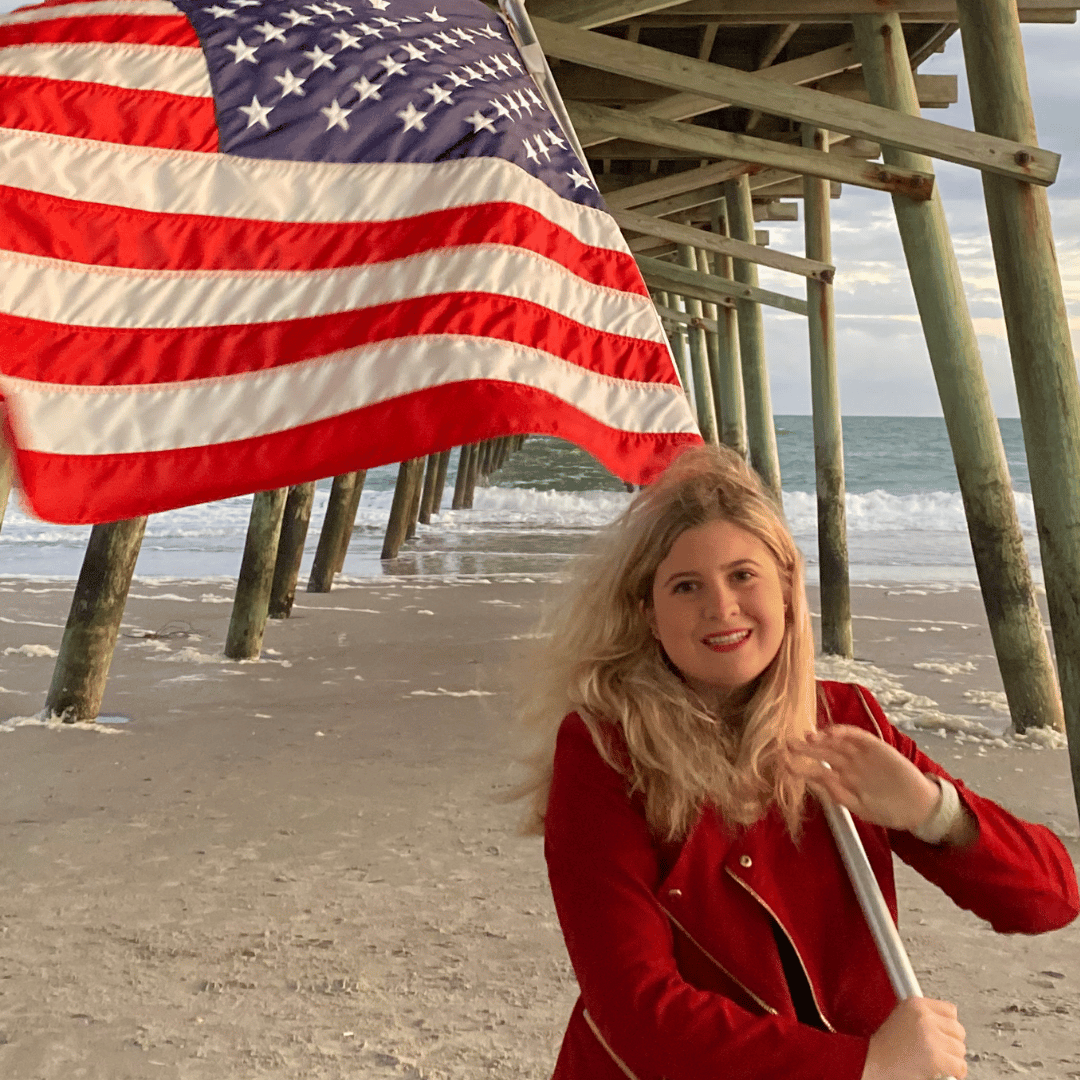 Reagan Faulkner is a student at the University of North Carolina Wilmington, where she currently serves as president of the university’s College Republicans chapter. Her leadership and passion for civic engagement have earned her national and local recognition, with appearances on The Ingraham Angle on Fox News, coverage in Fox Digital and The New York Times, as well as features in Wilmington-area news outlets and television stations.
Politics has been a lifelong calling for Reagan—fittingly, she was named after President Ronald Reagan. From an early age, she has been driven by a commitment to public service and a belief in the power of young voices to influence the future. She is especially passionate about educating the next generation of Americans on how to mobilize, inspire their peers, and create meaningful change.
Outside of her political work, Reagan finds joy in the simple things: reading, spending time at the beach with her boyfriend and friends, and boating with her family. Her values center on the preservation of American traditions such as the importance of the nuclear family, Christian principles, and cultivating respectful discourse across differences.
Reagan brings to the podcast not only her personal convictions but also an unwavering dedication to fostering conversations that challenge, encourage, and empower listeners to think deeply about the values that shape our society.
Full Transcript
What is up guys, and welcome back to the Regan Faulkner Show. I hope everybody had an amazing 4th of July weekend. I hope everybody got their fair share of fireworks and hot dogs and ice cream and hamburgers and I really hope that y'all got to go and do one of the amazing events that was probably happening in your town or city over the weekend or over the course of last week or this week.
Now, today I want to start the episode with 3 sentences and what I want y'all to do is hold all 3 of them in your head at the same time because this entire episode is really going to live in the space between those 3 sentences. So our first sentence is that America is unfinished. Not broken, but just unfinished.
Last week we celebrated 250 years since the Declaration. Y'all watched last week's episode or you read the article that got put out and you know the image that we keep coming back to. The founders did not hand us this finished statue that was perfect and they walked away in 1776 and they said it's done.
They didn't walk away with the Articles of Confederation and say it's done and they didn't walk away with the Constitution either and say it's done. They handed us an unfinished block of marble and a set of tools and every generation since has been expected to keep carving and keep making a more perfect union. Our second sentence is that the internet, the thing that most of us spend 3 or 4 or 5 hours a day inside of is a machine that is extraordinarily good at teaching us to perform judgment, to point, to donk, to own whoever you're trying to own, to make some crazy one-liners in the comments section, to have a take and specifically like a hot take will get rewarded or you'll get absolutely clapped in the comments on some hot takes, but it rewards the critic instantly.
So again, if you make that hot take and you're the critic, sometimes you get rewarded and if you make the hot take and it's a really hot take and you get clapped in the comments, the people in the comments are just getting rewarded, they're getting fed, the critic is getting rewarded instantly, but the builder, the people that are actually trying to construct something and make a difference, they get rewarded almost never on the internet. Number three, and this is the one I really want you to sit with this sentence as well as the space between all these sentences like I said before, history across 250 years keeps handing the credit to the people who actually made something, the people who built the schools, the companies, the churches, the towns, the technology, the families, not the people who stood on the sidelines and narrated how the builders were doing it all wrong. So here's the real tension, we have been handed the chisel, but we are living inside of a machine that would rather we live tweet the sculpture than actually touch it and make a difference.
So today we're going to be talking about the difference between the builder and the critic, why the critic is winning right now in my opinion and the opinions of many others and why the builder still ultimately matters more than what it actually looks like for our generation, Gen Z and Gen Alpha and everybody else out there as well, whoever's listening to pick up that chisel instead of your phone or your feed or your social media. So let's get right into it. If you've been with me over the summer, you know the whole point of these episodes recently is not to be chasing the 24 hour news cycle, not to be rage baiting, not to be reacting to anything, what we're trying to do is get behind the symptoms and look at the actual disease, the actual problems that are facing our country and then what we can really do about them.
So we've been doing one long thoughtful conversation a week instead of two episodes where it's more of reactions or diving into what's going on in the 24 hour news cycle. And I've been building towards this episode for a while because I think it might be one of the most important frames that we cover all summer, it really gets into one of the main symptoms that I believe is really harming my generation and could have the possibility of harming our country in the future. So here's the claim that I'm going to be defending today.
When people describe what's wrong with America, they almost always reach for one of two words. They say that we have an information problem. People don't know the facts.
They aren't being taught things in school anymore. They aren't aware of why things are happening. And then they can also say that we have a commentary problem.
There is too much noise, too many talking heads. I don't really think either one of these is the disease. I agree that both of them are problems.
We are drowning in information, yet it seems like almost nobody knows anything anymore. You can learn anything from anyone at any hour for free, but instead we would rather doom scroll and we are definitely drowning in commentary. I mean, I'm making some of it right now.
Y'all follow me on social. So I know that that's happening as well. But what we actually have is a formations shortage.
So formation is an older word. It means the slow work of shaping a person or a family or an institution into something that is trustworthy and durable. It's what a good school does to a kid over 12 years.
It's what a good church does to a congregation over decades. It's what a good company does to a young employee or a good coach does to a team. Formation is not fast.
It doesn't trend and you can't screenshot it. It is kind of like when we talk about the tortoise and the hare allegory. It is moving slowly like that tortoise and eventually it's probably going to win, but it's real boring to watch like watching paint dry.
And we have too little of it in our society right now. We have a shortage of people who are willing to trade performance for stewardship. They are unwilling to trade reaction for responsibility and they're unwilling to trade critique for construction.
We have more people than ever who can tell you exactly what's wrong with an institution, in their opinion, and fewer and fewer who are willing to spend 10 boring years trying to make that institution one little bit better. That's the disease. Not that nobody knows anything, not that nobody has an opinion.
It's that we've gotten really, really good, really good y'all at judging stuff and really out of practice at actually building or fixing them. And I want to be clear because this is a rule that I really live by personally. This is not me telling you to stop caring or stop critically thinking or to go quiet because criticism is necessary.
Criticism is very necessary. It's one of the the best forms of I mean, criticism and critique are the same, but it's intrinsic to our society. We cannot build anything or fix anything without first criticizing or critiquing it.
We have to understand what the problems are before we can build solutions. So honest criticism is, in fact, a form of stewardship. The problem isn't that we criticize.
The problem is that for many people in this country, criticism has quietly become the only thing that they do. It went from being a tool to becoming an identity. That's where we see titles like complainer or criticizer coming around or hater.
You know, that's one that's come up in the digital age is, oh, you're just a hater. So let's talk about why this happened, because it's not that our generation is lazy or shallow. It's because the system we live inside of was literally built to make the critic win.
So a couple of episodes ago in the episode where we talked about who really owns the algorithm and who owns the algorithm really owns the movement, we spent a while going on about just a lot about the algorithm and a lot about how outrage, I guess you could say, really performs well on the Internet. So we're not going to rerun the entire thing. You can go back and check out that episode, but kind of in a one sentence version, we're going to recap because it still matters here.
It's really integral to this episode. Many engagement driven algorithms are not designed to reward patience or nuance or intellectual honesty. They reward emotional intensity, moral certainty and outrage.
It measures reaction, not agreement. And it most certainly does not reward construction. I would love for y'all to think about the last time you actually saw somebody put something out on social media or on the Internet, whether it's in a video form or a post or a blog where they actually proposed a solution to a problem and it got a lot of traction or went viral, because personally, I cannot think of a single instance in my head.
So now layer that onto how our generation actually gets information. Now, according to Pew Research, about one in five Americans now regularly get their news from news influencers on social media. And among adults under 30, it's around 37 percent.
We talked about this statistic a few weeks ago as well. Roughly one in three young Americans is getting their sense of the world from creators, not from institutions, but from individual people. I've said it before, and I think a lot of that shift is inherently healthy.
We have been shown that our institutions aren't necessarily the most trustworthy places in society right now, and they don't always have our best intentions at heart. Now, sometimes they do and sometimes they are trustworthy, but not all the time. So it's pretty healthy to have a mix of individual people and creators who we would like to think don't really have anything to gain or lose.
They're just going to tell the truth. And then a mix with the institutions that should be telling the truth and historically have told the truth, but may or may not be leading with integrity right now. I think it's a it's a kind of healthy mix, in my opinion.
But creators feel human. Institutions often feel scripted and a little fake. And I don't know, just like kind of stuffy, I guess.
But watch what it does to the incentive structure. Commentary is cheap. It's fast.
It responds to events in real time. And it packages perfectly into a format built around engagement. A hot take costs you like maybe five minutes of your time and you'll be instantly rewarded in five minutes more.
Building costs the exact opposite. A better school, a stronger church, a revived mainstream, a cleaner, you know, a cleaner neighborhood or community, a local newsroom that people actually trust. Those things take years and years to show any visible return.
Any actual ROI can take sometimes up to a decade. And in a system that pays out instantly for reaction and in a society where we've been trained to just accept and desire instant gratification slowly, quietly, invisibly construction is is just developing. There's no instant gratification.
There's no instant reaction. So guess which one people are actually going to choose. The critic gets the dopamine now while the builder has to wait and they might not get applause at all.
They might not even see the fruition of what they worked so hard for. And here's the part that I really don't think is talked about enough because it goes way past strategy and into what this is doing to our actual heads, our actual brain space. There's real research now suggesting the habit of critical negative consumption is corrosive all by itself.
A twenty twenty four study in computers and human behavior reports found that doom scrolling was associated with higher existential anxiety and more pessimistic views of human nature in student samples from Iran and the United States. So we should be careful not to treat that as proof of causation because obviously, you know, causation and correlation, you've got that whole thing. Correlation is not equal causation, but it does fit what a lot of people are feeling right now, which is that constant negative consumption can train us towards distrust, despair and a general feeling that the world is unfair.
Again, that's something we hear constantly on social media and even in some of our personal circles today. So think about what that means. Criticism is not just a rhetorical posture anymore.
It's not just playing devil's advocate. It's a thing that you do and it can become a thing that you are, who you are. It can become an identity for a lot of people.
It's become a mode of attention as well. It's the water we swim in. You wake up, you pick up your phone before you've even had your cup of coffee in the morning and you've absorbed about 30 pieces of evidence that everything is broken and everybody is lying and everything is falling apart.
And then we wonder why we have an entire generation that feels like the only reasonable posture towards our country and towards our world is contempt. You can actually see it in the trust numbers. And this is where it stops being kind of like vibes and feelings and where it becomes cold, hard data.
The Harvard Youth Poll, this is the big one, they've been surveying young Americans since the year 2000, and they've recently released their most recently released their most recent numbers this year. It was a lot of recent ones. I'm sorry about that.
And they have found that just 15 percent of young Americans trust the federal government to do the right thing all or most of the time, just 15 percent. That is the lowest number that they have ever recorded. And here's the part that should really get everybody's attention.
A year earlier, that same number was 19 percent. So it's not just low, it's actively falling. And in that earlier poll, when they broke it out by institution, trust in Congress was 18 percent.
In the presidency, it was 23 percent. And in the Supreme Court, it was 29 percent. So fewer than one in three for any of those three institutions.
So put all of it together. You have a generation that gets its worldview from a feed that's engineered to reward outrage. You've got the act of consumption itself.
Quietly breeding despair. And then you've got trust in basically every shared institution sitting at literally near or at record lows. So, of course, the critic wins in an environment like that.
Criticism feels powerful because it's immediate and building feels weak because it's gradual. And then you have the whole situation where people don't even think it's fixable or worthwhile to build or try to find solutions. They just think that the whole thing is rigged and they're just pessimistic and full of despair.
But I want to plant a flag right here, and it's the main line that you should walk away from this whole episode with. Criticism feels powerful because it's immediate. Building feels weak because it's slow, but the slow things are almost always the things that last.
Now, if that's true, if the builder really does matter more than the critic, even though the critic wins the day, we shouldn't just assert it. We should be able to look at 250 years of this country and physically show it. There should be evidence of it.
So that's what we're going to do now. There's a speech that I think about a lot. It hung in the wall at the district attorney's office when I was an intern there, and it was basically written for this exact conversation more than 100 years ago.
In 1910, Theodore Roosevelt, who was out of office at this point, stood up in Sorbonne Paris and gave an address that was called Citizenship in a Republic. Most of it, quite frankly, people have forgotten. But there is one passage that has survived, and you've probably heard a piece of it or heard the entire thing or seen it on a wall somewhere else, even if you don't really know where it came from.
So Theodore Roosevelt said the following. It is not the critic who counts, not the man who points out how the strongman stumbles or where the doer of deeds could have done them better. The credit belongs to the man who is actually in the arena, whose face is marred by dust and sweat and blood, who strives valiantly, who errs, who comes short again and again because there is no effort without error and shortcoming, who at the best knows in the end the triumph of high achievement and who at the worst, if he fails, at least fails while daring greatly.
So, I mean, that's it. Like, that's the whole episode in one paragraph from 1910, to be honest. It is not the critic who counts.
The credit belongs to the person in the arena. Roosevelt understood before the Internet even existed, before we had all of these existential generational threats and problems, that pointing at the person doing the work is easy and cheap, but doing the work even badly or imperfectly and getting the dust and blood on your face, that's what actually moves a country. And here's what I love about American history.
When you look at it through this lens, the builders don't all come from one place. This isn't a story about a handful of great politicians. It's a story about a country that keeps getting renewed by the people who founded, by the people who organized, who scaled, who stewarded and left institutions behind them for us to take care of in the future, to build, to chisel and to keep improving.
Think about the range. You've got the republic builders, Washington, Madison, Hamilton, Franklin. You've got Lincoln holding the whole thing together against all odds.
You've got Theodore Roosevelt himself building the conservation system that Trevor and I were talking about a few weeks ago. The national parks, the idea that you steward the land that you're given. And then you've got Booker T. Washington building schools out of almost nothing.
Jane Addams building the settlement house movement. Norman Borlaug, a name most people don't know, whose agricultural work is credited with saving something like a billion lives from famine. You've got the industrial builders, Ford, Walton, Disney, Truett Cathy building Chick-fil-A.
You've got Fred Rogers building, of all things, a television neighborhood designed to form children into kinder, better people. And you've got the builders working right now, Millard Fuller and Habitat for Humanity putting families and homes in the engineers and companies like SpaceX and Anduril, which we're going to get to later on in this episode. Republic building, constitutional design, finance, education, conservation, science, industry, media, retail, philanthropy, defense, space, completely different sectors, many of them not even a fragment of a similarity holding them together, completely different centuries.
But here's the thing. They all share the same six traits. And once you see them, you really can't unsee them.
The first of those traits is that they accept imperfect starting conditions. Nobody in that list got a clean slate. They built anyway.
The second is that they organize people, not just ideas. A good idea in a notebook changes absolutely nothing. Builders are responsible for getting other humans to move and to build with them.
Number three, they build systems that outlast the founder. That's the whole game. If it dies when you leave, you didn't build an institution.
You, quite frankly, built a personality cult. Number four, they trade short-term comfort for long-term capacity. They do the boring, unglamorous, monotonous, just decade-long work to make a dream that they have happen.
Five, they prefer stewardship over vanity. It's not about the applause. On this show, we say it constantly, never confuse visibility with significance.
That's a motto that I live by. And six, they're willing to be judged by what's left after they're gone, which is the exact opposite of the critic who is only judged by what they said this morning. That's what builder means.
It's not a personality type. Instead, it's a pattern of responsibility. Now, we're going to go somewhere that might feel like quite the sharp term, but bear with me because it's really the crux of this entire episode.
Our founders were obsessed with a question that we hardly ever talk about anymore, and it wasn't about systems. It was about character. They did not believe that you could build a self-governing republic and then run it on procedure alone.
They believe free institutions require a certain kind of person in order to keep them standing and existing. In his farewell address in 1796, Washington said, of all the dispositions and habits which lead to political prosperity, religion and morality are indispensable supports. Now, whether you take that religiously or more broadly as moral formation, the point underneath is the same.
The machine doesn't run itself. It needs a people of a certain character to run it and to sustain it. John Adams said it even sharper in 1798.
Our Constitution was made only for a moral and religious people. It is wholly inadequate to the government of any other. Now, you can debate the theology of that all day.
I know where I stand on that, that we were built by a religious people for a religious people, but hear this structural claim because it is stunning, and it lands right on our formation problem that we're talking about. Adams is saying the Constitution itself, this beautiful piece of engineering, this feat in self-government, was never designed to be self-sustaining. It assumes habits.
It assumes character. It assumes a formed people. Which means, this is the entire point, the builders in that roster weren't just building things.
They were building people. They were doing formation. And the reason the critic can't replace the builder is that the critics produce neither.
A critic can tear down a bad institution. However, a critic alone can never form a single trustworthy human being. Only a builder can do that.
So, the question for us isn't just what should we build, it's who are we becoming while we build it? And quite frankly, who are we helping others become as we bring them in to have them help us build it? So, keep thinking about that. We're going to come back to it as we tie up this episode. So, if the builders are what renew a country, the obvious next question is, how are we doing right now? And the honest answer is thinner than we should be.
Not zero, not nothing. But in several of the specific places that make self-government actually livable, the institutions are visibly thin. Let me give you the dashboard of what we're working with here.
And I want you to notice that these are not left problems or right problems. They're problems that all Americans face. These are American problems across every political divide.
We're going to start with trust because we kind of already started with trust. Youth trust in the federal government is at 15%, a record low and still actively falling. But it's not just in the government.
Gallup found that confidence in the US judicial systems and the courts fell to 35% in 2024, also a record low down from 42% just the year before. That's the rule of law that we're talking about, guys. That is the thing that holds us together as a moral society that keeps us from pure anarchy.
And here's why that number matters beyond politics. When people stop believing an institution deserves repair, the natural next step is to believe that it only deserves contempt. Now, kind of think about that.
If we see the judicial system falling and we've seen people wanting to defund the police, you are seeing contempt for the institution that people don't believe deserves repair. It's, you know, A plus B equals C. Low trust doesn't just make critics, it makes it feel pointless to build. And it can make it feel positive to tear down.
Then there's pride, which sounds soft but isn't. Gallup found that only 58% of American adults said they are extremely or very proud to be American in 2025. We touched on that last week.
That is the lowest level in the 25 years that they've asked that question. And when Gallup looked at generational data across 2021 to 2025, Gen Z was the lowest. Just 41% said they were extremely or very proud to be an American.
So the generation that's been handed the chisel is also the generation that's least sure the thing is even worth carving. That's the emotional core of our entire problem here. Now, let's get physical because not all of this is about feelings.
We need some feelings and some physical as well. Some of it is about whether we can literally build the country. Housing.
In 2024, existing home sales fell to about 4.06 million, the lowest level since 1995. Think about that. The population has grown by more than 70 million people since 1995.
And we have sold fewer homes. And at the same time, the median home price hit a record high, $407,500 that year. And it's climbed even higher since, with the most numbers having it around $429,000.
A society that cannot build enough housing is very literally failing to build a place for people to live and to start families and to build. This is one that Trevor and I got into on that same episode I mentioned earlier. Overdevelopment, affordability, young people who did everything right and still can't buy in.
It's the builder deficit you can see from the road, quite frankly. Local news. Researchers at Northwestern's Metal School put out their state of local news report, and the numbers are pretty rough.
213 counties in America now have no local news source at all. Another 1,524 counties have only one local news source. Add it up, and roughly 50 million Americans have limited or no access to local news.
And when local news gets thin, everything downstream gets thin too. Accountability, civic knowledge, even a town's sense of itself, who it is, what it is, its history. One of the researchers put it beautifully, saying, local news is the glue that lets a community see itself.
Think about all those Hallmark movies that you've probably seen, or shows like Gilmore Girls. They all had a gazette. I believe it was the Star News Gazette and the Hallmark movies.
They always have those local papers. All of those towns have a deep sense of pride, but when you don't have that, you kind of lose who you are as a community. Going to religious life, and this one doesn't cut.
Moving on to religious life, Pew's most recent religious landscape study finds that the country is about 62% Christian and 29% religiously unaffiliated. And the age gap is enormous. Among the oldest adults, about 80% identify as Christian, and among the youngest, it's about 46%.
Now, whatever your own faith is, here is the civic point of that. For most of American history, churches and congregations were thick community infrastructure. They were where you learned to show up for people who weren't your family, and it was where you learned to volunteer.
It was where you learned to respect your elders and to have manners. And as that thins out for a big chunk of the country, something has to replace it. And as of right now, really nothing has.
And then we move on to volunteerism. Membership in the durable showing up every kind of week of civic life. But, and I don't want to stop here because this is where the story turns, and we're not going to stay in doom.
The volunteer numbers are actually really uplifting. The volunteer number is, I mean, it's really hopeful. It's really, it shows that we're not all gloom and doom.
It shows that Gen Z isn't actually just full of selfishness and wanting to just care about themselves and what benefits them. The Census Bureau and AmeriCorps found that formal volunteering rebounded to 28.3% in 2023, about 75.7 million Americans, up from a record low of 23.2% in 2021. That's the largest two-year jump in volunteering they have ever recorded.
Informal helping, just helping your neighbors, went even higher past pre-pandemic levels. So here's the truth. The volunteerism rebound suggests many Americans still want to build.
They still want to help others. They still want to construct and make a difference. The instinct is not dead.
What's thinned out is the durable structure, the institutions that turn that instinct into something that is lasting. And the gap right there is the entire opportunity that we have, because it means the raw material is there. The desire is there.
What's missing is builders willing to give it a shape. So this is the part where I want to name two more people whose work basically maps out this entire segment, and then we're going to move on before it gets too academic, because these are some pretty big books here. Robert Putnam wrote a book called Bowling Alone, the clearest diagnosis I know of what happens when Americans stop joining things, stop showing up, and start spectating instead.
And Yuval Levin wrote a book called A Time to Build, and his core argument is the one that this whole episode is really built on. He says our institutions have stopped being places that form us and turned us into stages that we perform on. Sounds pretty much like where we are right now, huh? We treat a school, a church, a Congress, a platform as a backdrop for our own personal brand instead of a thing that shapes us and that we are responsible to.
You don't have to read either book to get the point. America is weaker exactly where commitment got replaced by spectatorship, where we stopped being members and started being an audience. So the question becomes, is real building still even possible, or is this just a nostalgia episode? And the answer is, it's 100% still possible, and I can prove it because it's happening right now in real time in several places at once across this country.
So here's the proof, not the vibes, not a pep talk. I have brought the receipts, and I'm ready to show them to y'all. Start with something that is about untweetable, unglamorous as it gets, a factory in Ohio.
I bet you didn't know we still had those. There's a defense technology company called Anduril, co-founded by Palmer Luckey, the guy who built the Oculus VR headset before he was even 30 years old. And Anduril is building a facility in Pickaway County, Ohio, that they literally named Arsenal One.
It's 5 million square feet, and here's the commitment on record with the state, 408,000 new jobs, and at least $910.5 million in capital investment over 10 years. It's the largest single job creation project in Ohio's entire history. Operations are scheduled to begin this month, July 2026.
That is right now, guys. And this is not a tweet, this is not a tag, this is thousands of Americans, engineers, welders, machinists, software people, physically building something that says manufacturing and defense and hard engineering can be an American builder story once again. That's not something of the past.
When I say builder generation, that's what I mean. And notice, I didn't call it, or they didn't call it an innovation center, they called it Arsenal. They called it a thing that you build.
You build up an arsenal. They are building this thing up. They are building up industry in America once again.
Then take a look up to the stars in the sky, SpaceX. Forget the personalities, and I mean, I think Elon is a great guy, but if you don't think Elon is a great guy, forget the Elon part of it. Just look at the number, because the number tells the entire story of what building actually looks like.
In 2025, SpaceX launched 165 orbital missions, 165. That is roughly one launch every other day all year. It accounted for about 85% of all U.S. orbital launches, and it was more than the rest of the world combined.
But here's the part that you really need to remember, because it's not actually about the rockets, even though the rockets are really cool. Look at the trajectory, no pun intended. In 2020, they launched 25 times, then 31, then 61, then 96, then 134, then 165.
A new record for the sixth year in a row. That is what building looks like when a company gets good at iteration. You don't leave, you compound.
You get a little bit better and a little bit better and a little bit better until one day the future just feels normal. Builders compress the distance between an idea and its execution until the impossible becomes routine. That's the lesson, and it's got nothing to do with space.
It's all about compounding. Now, and this is the part that I personally care about the most, because I don't want anybody hearing builder generation and thinking it's only for elite founders and rocket engineers and people who just have crazy degrees and stuff that we don't, because it's not. The trades, think about the trades.
Reporting on national student clearinghouse data showed that enrollment in vocational and trade-focused two-year programs jumped 11.7% in the spring of 2025, the third straight year of strong growth. Young people are looking at a mountain of student debt and a shaky entry-level market. We did an entire episode about the college ROI problem a couple of months ago, and a lot of them are choosing to go and build things with their hands instead.
Welders, linemen, HVAC techs, machinists, carpenters, electricians, the people who make local systems actually function. And as of this month, July, 2026, a new federal program called Workforce Pell is beginning to extend financial aid up to roughly the maximum Pell award of about $7,400 to short-term skills programs in exactly those fields, HVAC, welding, healthcare, IT. For decades, Pell grants were mostly tied to traditional undergraduate pathways and longer credential programs.
Workforce Pell grants changes that by opening Pell funding to qualified short-term workforce programs. Now, for the first time, the country is starting to put real money behind the person who wants to be a builder in the most hands-on sense of the word. And I keep coming back to a line from Booker T. Washington on this because he saw it in 1895.
In his Atlanta exposition address, and I'll note that this was a debated speech, people argued fiercely about it then and since, but there's one image in it that's pretty true and pretty timely for this episode. He told a story about a ship lost at sea, dying of thirst that signals a passing ship for water. And the answer that comes back is cast down your bucket where you are.
The water was right there the whole time. And his point was to a generation trying to figure out where to build. His point was there is, in his words, quote, as much dignity in tilling a field as in writing a poem.
So his point was build where you stand with the neighbors and the tools and the obligations already in front of you. You don't need permission and you don't need to go somewhere else. You can cast your bucket down right where you are right now today.
And then we're gonna talk a little bit about AI because I know that somebody out there is waiting for me to say it. Or if you're like me and you have been in college all year, you are just begging somebody to not say it. And if you're that person, I'm really sorry because I'm gonna say it.
Here's the thing that everybody gets wrong about AI. The Census Bureau survey suggests data that Census Bureau survey data suggests business AI adoption has climbed from under 4% of firms in the early BTOS measurements to roughly one in five by mid-2026. Though adoption still varies drastically by industry and company size, as we all know.
And the builder versus critic frame changes the entire AI conversation because the interesting question was never is AI good or bad? You can have a million different perspectives on that. And we all do. The interesting question is what are we going to build with AI? Are we going to use the most powerful tool of our lifetime to build better schools, better campaigns, better nonprofits, healthier churches, more trustworthy local news, small businesses that actually work for real people? Or are we going to use it to extract a little more attention out of an already exhausted country? That's a builder's question.
And it's up to us to answer it as AI becomes more and more mainstream. This brings me to my last piece of proof. And it's the one that hits closest to home because it's this right here, media itself.
If criticism scales for free on these platforms, and it does, we all know it. Then one of the most quietly patriotic things you can do right now is to build a trustworthy alternative, a podcast, a local newspaper, a civic paper for a town that's already lost its own, a tutoring program, an apprenticeship network, a neighborhood nonprofit. Remember those 213 counties with no local news? Here's the hopeful half of that story that doesn't make the headlines.
More than 300 local news startups have launched in the last five years. People are already casting down their buckets where they are. They're already building.
So no, building is not dead. It's not even rare. It's just quiet.
And quiet has never trended. But quiet is what lasts. So here's what I want you to walk away with.
I don't want Builder vs. Critic to just be a nice idea for one episode. I want it to be a lens, a question that you can hold up to literally any topic.
And I think it's clean enough to become one of the permanent frameworks of not only this show, but of everybody's life. I think it's pretty fair if you want to be a Builder, if you want to change this country or change your community or change your school or your institution, wherever you are, it's a pretty easy framework to hold up and use. It doesn't take a lot of anything, really.
Watch how it travels. Let's take education. The Critic's question is, which failing school can I mock today? The Builder's question is, are we building better schools or are we just dunking and owning broken ones? Take the media, for example.
The media asks, or the Critic asks, who can I own? Who can I, you know, own the libs? Who can I take a nice little shot at today? The Builder asks, am I building something more trustworthy than the thing that I'm complaining about? Take politics, for example. The Critic asks, did we win the content cycle this week? The Builder asks, are we building institutions that will outlast this election or whoever is in office right now? And that one matters so much for our generation specifically, because this is what I warned about in the algorithm episode. You can absolutely win the internet and lose the country.
You can become a professional rage baiter for a living with a huge following and zero, absolutely zero ability to actually govern, to actually build, or to actually solve a single real problem for a single real person or real family. The goal was never and should never be to be the loudest. The goal is to be the most trusted.
It's to build, trust is built by consistency and competence, not by escalation and rage baiting and outrage. Take AI. The Critic asks, is this going to ruin everything? Where we see the Builder asking, am I building tools that strengthen human capacity instead of replacing it? Take business.
The Critic asks, how do I extract more attention? The Builder asks, am I actually creating value for real legitimate people? And take one nobody puts on the list, your own family, your own street. The Critic asks, why won't somebody fix my community? The Builder asks, what am I actually responsible for here? Do you see that lens? It takes ideology, left, right, center, whatever you may be, and it converts it into responsibility. It stops asking who's to blame and it starts asking, what can I build or how can I fix it? And it does that without going cynical, which is the thing that I care most about because I've made a rule to reject cynicism.
Cynicism is just criticism that gave up, honestly. And this is where it all ties back to last week and where it ties into this year, 250 years, just because the 4th of July is over doesn't mean that the celebration and just the sheer dumbfoundingness of the fact that we've made it this long, 250 years, just because the 4th of July is over doesn't mean that we stop thinking about that. I gave this quote last week, but Ronald Reagan said something in 1961, and I still think it is the single best sentence about what it means to inherit a country.
I've talked about it. Brylon Hollihan basically wrote an entire book about it, and that is, quote, freedom is never more than one generation away from extinction. We didn't pass it to our children in the bloodstream.
It must be fought for, protected, and handed on for them to do the same. Not passed down in the bloodstream. That's the whole thing wrapped up in one sentence.
Freedom in every institution that protects it is not automatic. It's not genetic. It doesn't just keep working because it worked for your grandparents or your great grandparents.
Every single generation either builds it forward or lets it thin out. There's no neutral. There's no coasting.
You are either a steward or you are a spectator, and the spectator is quietly voting to let it decay. That's not a flaw. That is a design.
Like, it's not a flaw in the system that you can't be a spectator. That is the design. That's the best part of it.
America's unfinished on purpose so that there's always something left for you to build. The chisel was never a burden. It's an invitation.
So let's bring this thing all the way home. Let's wrap it up. Your generation, my generation, we do not have an information shortage by any means.
You can learn anything. You don't have a shortage of commentary either. Trust me, we are all filled up in the commentary department.
What we have is a formation shortage. Too few builders and way, way too many spectators. Too much of our attention pointed at judging the sculpture and not enough of our hands actually on it.
And I don't think the answer is a big inspirational speech about how you're gonna change the world. Maybe you are, but I think the answer is smaller and harder and more real than that because here's what I've learned from watching the builders and studying the builders from George Washington to Booker T. Washington to the people breaking ground on a factory in Ohio and opening operations up this month. They didn't start with the whole country.
They started with the thing that was right in front of them. They cast down their bucket where they were. So we're not going to end this episode with a call to save America.
Yes, America needs saving, but one person is not going to be able to do it. That's too big and it lets everybody off the hook, honestly, because everything is just another way of saying nothing. Instead, I'm going to leave you with the exact question that I asked myself and now I ask, you know, before I write each of these episodes and it's the one that hangs over everything that we do and I want you to actually sit with this one, not just scroll past it.
What institution am I responsible for strengthening right now? Not someday, right this very second. Maybe it's your family. Maybe it's your church or your team or your major or the club you're in or the small business you work for or the town that you grew up in that has lost its newspaper.
Maybe it's a group chat that could be a real community. Maybe it's this generation's media and the honest thing to do is build a better version instead of just consuming a broken one. Pick one and leave it stronger than you found it.
That's the assignment and that's the whole point of this entire episode. That's what it means to be handed down the chisel and to actually use it because the critic gets today, the builder gets the future. And I think our generation is a lot more built for the arena than the internet and the critics have led us to believe.
If this episode meant something to you, do the builder thing and not the critic thing. Don't just scroll on. Be sure to subscribe and share it with someone who you think is more of a builder than just a spectator.
And then drop a comment telling us one institution you're going to strengthen right now. And I love reading the comments. So if y'all get enough, then the best thing would be if I could make an episode about all the institutions that all of you are going out to improve and we can talk all about that in the future.
So I'd love to see it. You can find the show and everything we're doing at the Reagan Faulkner Show and at the Wilmington Standard on Instagram, Facebook, TikTok and X. We're going to keep going deeper on a lot of these frameworks all summer. And this builder versus critic lens is one that we're going to come back to a lot.
I think it's a really interesting idea because it's one of the defining questions of our generations. And if you haven't tried 7 Weeks Coffee yet, be sure to check it out. Use code REAGAN2026, all caps.
It is the best coffee ever and it goes to a good cause, helping babies and mothers in crisis pregnancy centers. Thank you all so much. And I cannot wait to see you on the next one.
On Page Navigation
Opinion Articles

Answering Socialism: The Conservative Problem
Bichler’s Water Attacks on Michael Lee Collapse Under the Facts