First In Freedom
What America 250 Should Actually Mean to Gen Z
Episode 45
July 1, 2026
Watch The Reagan Faulkner Show on YouTube
Listen on Buzzsprout
Like and Subscribe



On Page Navigation
Show Notes
Episode Summary
America is about to turn 250, and Reagan Faulkner argues that this milestone should hit Gen Z as a calling, not just a party. She walks through how the United States became the world’s longest-running written constitutional government, why patriotism is a tradition that has to be handed down, and how that transmission broke for her generation. Then she heads home to North Carolina, unpacking the real “First in Freedom” story—from Cornelius Harnett’s Stamp Act resistance in Wilmington to the Halifax Resolves and Moores Creek Bridge. Along the way, Reagan makes the conservative case that our job at 250 is to pick up the chisel, reclaim our local founding stories, and decide—on purpose—whether this experiment in self‑government keeps going.
What you’ll learn / Key moments
- 00:00 – Why Reagan opens America 250 week with awe instead of cynicism, and why she calls this milestone a near‑miracle in world history.
- 04:30 – How the United States became the world’s oldest written constitutional government, and why most other constitutions are younger than the microwave.
- 09:45 – The Gallup numbers on collapsing American pride, why Gen Z is the least proud generation, and how politics shifted from “what you believe” to “who you are.”
- 15:30 – Why patriotism is a tradition that has to be handed down, how that transmission broke for Gen Z, and why disconnection is often mistaken for hatred of America.
- 21:50 – The real “First in Freedom” story: Cornelius Harnett, the Stamp Act bonfires in Wilmington, and how North Carolina became the only colony to never issue a Stamp Act stamp.
- 28:10 – The women who stepped up first: Penelope Barker, the Edenton Tea Party, Wilmington’s Ladies Tea Walk, and what their courage means for young conservative women today.
- 33:20 – What “First in Freedom” on the North Carolina flag really means, the Halifax Resolves, and why North Carolina was the first colony to authorize independence.
- 38:15 – Two paths at America 250, why indifference is not a neutral third option, and how conservatives can “out‑belong” the Left by handing down a hopeful, honest American story.
What You Can do
If this episode gave you even a flicker of pride or ownership in America’s story, do not let it stop at a feeling—turn it into action. Follow The Reagan Faulkner Show on Instagram, Facebook, TikTok, and Substack so you can share this America 250 conversation with the next generation that needs to hear it. Stay plugged into the local fight by following The Wilmington Standard on Instagram and Facebook, where we tell the “First in Freedom” story from right here on the Cape Fear coast.
And as you celebrate our 250th, grab a bag from Seven Weeks Coffee, use code REAGAN2026 at checkout, and know that 10 percent goes straight to crisis pregnancy centers across the country—supporting moms and babies while we honor a nation founded to protect life and liberty. The experiment only survives if we decide to carry it, so pick up the chisel and join us.
About the Host
Reagan Faulkner
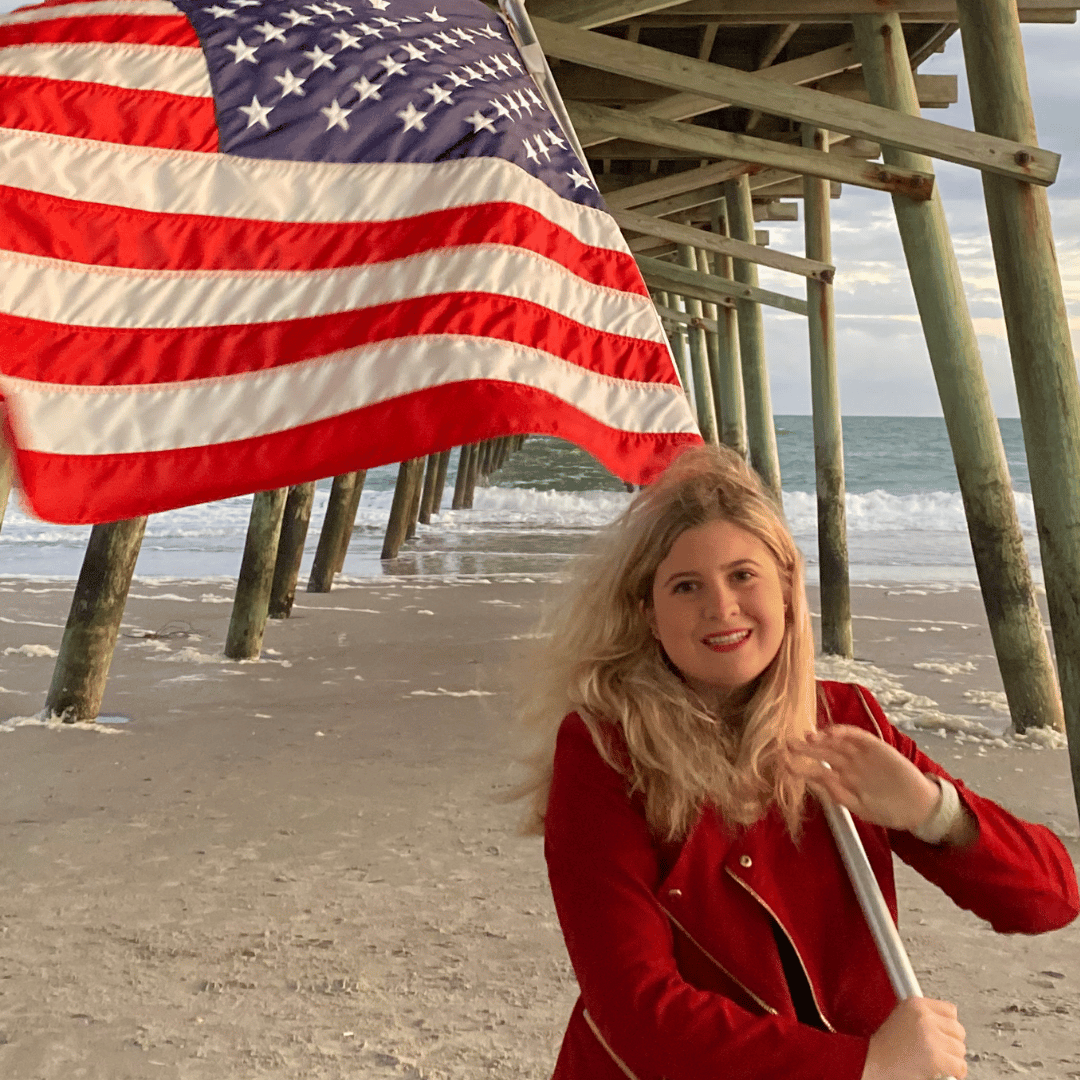 Reagan Faulkner is a student at the University of North Carolina Wilmington, where she currently serves as president of the university’s College Republicans chapter. Her leadership and passion for civic engagement have earned her national and local recognition, with appearances on The Ingraham Angle on Fox News, coverage in Fox Digital and The New York Times, as well as features in Wilmington-area news outlets and television stations.
Politics has been a lifelong calling for Reagan—fittingly, she was named after President Ronald Reagan. From an early age, she has been driven by a commitment to public service and a belief in the power of young voices to influence the future. She is especially passionate about educating the next generation of Americans on how to mobilize, inspire their peers, and create meaningful change.
Outside of her political work, Reagan finds joy in the simple things: reading, spending time at the beach with her boyfriend and friends, and boating with her family. Her values center on the preservation of American traditions such as the importance of the nuclear family, Christian principles, and cultivating respectful discourse across differences.
Reagan brings to the podcast not only her personal convictions but also an unwavering dedication to fostering conversations that challenge, encourage, and empower listeners to think deeply about the values that shape our society.
Full Transcript
What's up, guys, and welcome back to the Reagan Faulkner Show. Now, today is going to be a really, really fun episode. I am so excited to do this one.
It is a little bit different than normal. We're going to be doing some history stuff today instead of just political commentary. But I cannot wait for you all to join me on this special America 250 episode of the Reagan Faulkner Show.
Now, if you're anywhere in North Carolina this week or quite frankly, in America this week, you can feel it in the air. There is no escaping it. It is July 4th week.
We are coming up on the weekend and it is 250, which is huge. The last time there's been any type of celebration like this was in the bicentennial in 1976. So it has been a hot minute since we have felt this degree of excitement in the air coming up on July 4th weekend.
And I mean, it's just going to be huge, guys. It is going to be absolutely massive. On July 4th, 2026, the United States of America, we are turning 250 years old, a quarter of a millennium since 56 men in Philadelphia signed their names to a single sheet of paper and in doing so launched what I genuinely believe to be the greatest political experiment for the entire human race.
In the country, we are we are throwing ourselves a party to match, guys. We are throwing ourselves just in enormous birthday party celebration all out rager down or up in Washington, D.C. For me, they're planning what's being billed as the largest fireworks display in the history of the world. Now, I've asked a couple of people like what the metrics for that are.
I'm a little curious how we're making sure this is the greatest fireworks display of all time. But I'm sure they've got it covered. They are planning hundreds of thousands of shells and explosives and fireworks over the National Mall and the Potomac now up in New York in their harbor.
They are actually having what they're calling sale to 50 hosted by the Navy with tall ships from dozens of countries coming in and what organizers are saying will be the largest maritime gathering in American history. Now, the U.S. Mint has restruck the coins in your pocket with a dual date, 1776 to 2026. And right here in our state of North Carolina, the North Carolina State Capitol in Raleigh is hosting a free all day festival on the 4th of July, complete with a public reading of the Declaration of Independence and a super special naturalization ceremony for brand new legal American immigrants to take the oath of citizenship on the nation's two hundred and fiftieth birthday.
Now, that is what I call a celebration down to a T. Now, I could open this episode in a lot of different ways, especially in a cynical way, but that is not what I want to do. Now, the reason I say that is because in this exact same week that we are all excited and hyped up about America to 50, Gallup actually released a poll finding that American pride is at the lowest level they have ever recorded and that my generation, Gen Z, is actually the least proud generation in the entire country. And believe me, we are going to talk about that number because it is critical.
But we're not going to do it in any sad, soppy, cynical kind of way. I'm not going to lead this episode with despair. Quite frankly, I don't like despair.
I think it's way better to be hopeful and find a solution than to be just depressed and rage baiting yourself. It's easy, it's lazy, and it's really just quite boring, to be honest with you. And it's just the wrong emotion to have.
So that is not what we are going to be doing today. We're going to put a nice little happy spin on this. But here's what I want you to feel this week instead of despair, instead of concern over your political ideology or what we saw in the Supreme Court this week or current events or whatever popped up on your Instagram, TikTok, Facebook feed today.
I want you to feel the emotion of awe, of just genuine support and awe for what we have been able to do in 250 years. 250 years, guys, is not normal. It is not a given.
It is, historically speaking, almost a miracle. If this was a call she bet back in 1776, we would not we would not be doing well on call. She back when we first started this little experiment of ours.
So we we are really in a place where we need to be proud of this, where we need to be awestruck, where we need to be just amazed at what we've been able to do. Most nations never come anywhere close to 250 years. And the fact that we are still standing here free, self-governing under the exact same founding framework our great, great, great grandparents fought for is one of the rarest achievements in all of human history.
So we're not going to be gloom and doom. Everything is broken because we're still doing pretty good in the grand scheme of other countries. If you've been with me for the last couple of episodes, the last couple of months, you know that I don't flinch when it comes to the hard data.
We've been looking at a lot of hard data recently. But today on America's 250th birthday, I want to do something different. I want to talk about why this milestone is extraordinary, why my generation got disconnected from the story and the incredible piece of history that's actually hiding in my own backyard right here in North Carolina and the decision every single one of us has to make this 250th birthday, because that's what a 250th birthday really is.
It's not just a party. It's a choice. And we are going to get right into it right now.
Now, let me start by making the case that should be obvious, but somehow isn't really taught anymore, to be quite honest with you. And that is what America has done in the last 250 years is genuinely historically astonishing. It is a miracle and it is not something that we should take for granted or take lightly or feel that we are entitled to.
We do take it for granted. Most of the time, we assume that countries just sort of kind of exist. They're bland and they just kind of sit there and they exist.
And we've all been dealing with the same general countries throughout most of our lifetimes, aside from like the USSR. They tend to last. We assume that governments kind of roll on forever.
But that is not how history works. History is a graveyard of nations, of empires that rise and rot, of republics that collapse into tyranny, of borders that get redrawn, regimes that get overthrown and the average country that you point to on the map has been refounded, reconquered or rewritten more times than most general Americans really realize. Here's a fact that should literally stop you cold, and it is rock solid.
The United States has the oldest written framework of government on planet Earth. I'm going to say that again. The United States has the oldest written national framework of government on planet Earth.
Our constitution has been continuously in force longer than any other constitution in the world. Let me put numbers on how rare that is, guys. Of the roughly 159 other national constitutions in the world, about 101 of them were adopted after 1970.
Think about that. Most of our parents were born in the 70s or before the 70s. Think about that.
The overwhelming majority of the world's governing charters are younger than the microwave oven. And while the United States has been governed under a single continuous framework for nearly two and a half centuries, France, France, guys, one of the great civilizations of the world, one of the the great European countries that we always talk about in the Eiffel Tower and people want to go there and live there and visit their vacation there has run through 10 separate constitutional orders in that span. Five republics, two empires, a monarchy and two different dictatorships.
The little country of El Salvador has had 36 constitutions since 1824. We've had one, just one. And here's my favorite part of this whole thing.
This is the part that makes this human instead of just a statistic. The founders themselves didn't think it would work. George Washington, the George Washington, reportedly said that he didn't expect our constitution to last more than 20 years.
I'm 21. OK. He thought the Constitution was going to last less time than I've been alive.
The most respected man in America looked at what they built and he privately wondered if it would even survive two decades. It has survived 237 years. That is the experiment.
13 squabbling colonies, a bunch of men who, quite frankly, didn't fully trust each other or their own creation, betting everything that they had on a radical idea that ordinary people could govern themselves without a king. Every expert in the world at the time would have told you that that idea was doomed and it wasn't. We are still here.
We still have no kings. Now, I want to be really honest here, because this is the part that separates real patriotism from cheap fake dollar general dollar tree patriotism. You know, the cheap stuff that many people probably bought on Amazon this week.
Two different types of patriotism here, y'all. And it's the key to this entire episode and why I'm so excited to bring it to you all today. The founders never, not once did they ever claim that they got this thing perfect.
They never said America was finished. They never said that they built a flawless country. Read the actual words.
The Constitution doesn't open by declaring we, the people of the United States, a perfect union. It opens by saying we, the people of the United States, in order to form a more perfect union, more perfect, not perfect. But more perfect.
Continuously something to strive for a goal. This is one of the most important phrases in the entire American project. And almost nobody thinks about what it actually means.
We memorize it in civics class and then we kind of move on. And some of us still remember it. And then some of us just kind of forget it ever really happened.
The founders built imperfection right into the literal mission statement of our country. They knew they were flawed men. They knew they were leaving problems unsolved.
Some of them were enormous. Some of them were shameful. And we're not going to pretend otherwise.
We're not going to pretend like that piece of history never happened. Slavery existed at the founding. Women couldn't vote at the founding.
The promise that all men were created equal was written by people who, quite frankly, did not live up to that premise yet. But here's what those men also did. And it's the genius of the entire thing.
They built a machine that was designed to correct itself, to fix its problems, to grow and mature into a more perfect union. They wrote the Constitution in a way that it could be amended. They created a system where the country could be argued with, where it could be pushed, where it could be reformed and improved by every generation that came after them.
They did not hand us a finished statue. They handed us a chisel. The whole point of a more perfect union was that the work would never fully be done.
And that each generation's job was to take the country a little bit closer to its own founding ideals. So here's the idea that we are going to carry with us through the rest of the episode. America was never about being perfect.
It was about the pursuit of excellence, knowing that we'll always fall short of perfection and refusing to stop striving anyway. That's not a weakness in the American story. That is the American story.
Every generation inherits a country that's better than the one before and still not good enough and gets handed the chisel. The abolitionists took a swing. The suffragettes took a swing.
The civil rights generation took a swing. Every one of them made this more perfect of a union without ever making it a fully perfect utopia. And now that chisel is being handed to us, to Gen Z, to Gen Alpha, to the new generations.
So the question for my generation was never is America perfect? Because of course it isn't. When has a nation ever been perfect? If I'm asking to be to be honest, we've never seen that in the course of human history. We've never seen a perfect union or a perfect nation.
We never claim to be a perfect union or a perfect nation. The real question is, are we going to pick up the chisel and keep carving? Or are we going to walk away from the whole darn thing? Which brings me to the hard part, because right now my generation is tempted to walk away and we need to talk about why. So let's dive into that Gallup number.
I said that we're going to. They're not fun numbers. It's not a fun poll or a fun statistic, but you can't fix a problem.
You won't name or ignore every poll that you don't like. So according to Gallup's brand new polling released right before this 4th of July, only about 53 percent of American adults say that they are extremely or very proud to be an American. That is the lowest reading Gallup has measured in the entire 25 years that they've been asking this question.
When they first asked it back in 2001, extreme pride alone sat at 55 percent. After 9-11, it surged to almost 70 percent. Today, the share who say that they are extremely proud has fallen to around only one third of the country.
And the generational breakdown is really the core and crux of this thing. Averaging across recent years, only about 41 percent of Gen Z said that they are extremely or very proud to be an American. Compare that to up the ladder.
We've got 58 percent of millennials, 71 percent of Gen X, 75 percent of baby boomers and a whopping 83 percent of the silent generation. And the very latest poll among adults, 35 among adults under 35, only 14 say they are, quote, extremely proud. So here we are at the most improbable and extraordinary milestone in the nation's entire history.
Two hundred and fifty years, a miracle by literally any historical standard. In the generation that is inheriting this country, it is the least sure that they're even worth being proud of it. And that's the paradox.
I don't think it's a mystery. I think it's the direct result of everything that we've been documenting on the show over the last couple of weeks and couple of months. So let's connect the dots really fast.
We're going to do like a really, really quick rewind because we've done full episodes on all of this. But we talked about how politics became identity first. We talked about how it stopped answering, what do you believe? And started answering, who are you? We talked about why Gen Z distrust institutions more than any generation before us and why trust trust in individual people and creators is greater than trust in organizations.
And then we did the big rock episode where we argued that traditions are technology, plain and simple. The most efficient system humans ever created or invented for handing down identity and belonging from one generation to the next was the idea and development of the tradition. So here's the thesis that really ties all of this together.
And I want to say it super, super clearly so that everybody hears it and catches it. Patriotism at its core in and of itself is tradition and traditions have to be handed down. Not a single person on Earth is born knowing why their country is worth loving.
They're not born knowing anything about their country. And quite frankly, that's a little bit why we're in the situation that we're in today. It isn't in the bloodstream.
It quite literally has to be transmitted through families, through schools, through churches and communities and the stories that are told until they become part of who you are and who we are as American citizens. And for a lot of my generation, that transmission got interrupted. Here's what I mean, and I'm going to be fair to everybody across the board.
When I say this, a lot of us grew up hearing plenty about America's failures and those failures are real. And we should absolutely know about them from a historical context and, you know, just a general historical literacy understanding of them. But we got the failures without the inheritance.
We got the indictment without the story of the ideals that made the indictment possible in the first place. We learned what was wrong with the country before anyone taught us what was breathtaking about it. And I want to steel man that thoughtful version of low pride because it exists and it does deserve a little bit of respect and acknowledgement.
There are people, including a former history teacher who was quoted in the coverage of this very poll, and they say something along the lines of, as she did, quote, I'm proud of this country precisely because of how far it's come from slavery, from segregation toward being a more equal nation. You know what? That's not anti-American. That's exactly the more perfect union mindset that we've been talking about.
And and I do respect that perspective because, yes, we we can look at where we started and where we've come and be proud of that while knowing that we still have a long way to go. But here's where I want to gently push my own generation because the mature, clear eyed pride is one thing, but full on disconnection is a whole nother thing. And too much of what shows up in the Gen Z numbers isn't thoughtful critique.
It's just distance. It's never having been handed the story at all. And here's the genuinely hopeful part.
The reason I'm actually optimistic instead of despairing in this episode and in my own personal life, you cannot be disillusioned by ideals that nobody ever taught you to believe in in the first place. A generation that simply disconnected from their country's story is not a generation that hates its country. It's a generation that's never been properly introduced to it.
You can't hate a person that you've never actually been introduced to or met. Therefore, you can't hate a country that you've never been properly introduced to and met its history and its key players and all the different stages that that country has gone through to be where it is today. And that that is a completely fixable problem.
You don't fix disconnection with a lecture. You don't fix it by scolding young people into being crazy patriots. And you definitely don't fix it by handing them an even longer list of grievances and problems.
You fix it in the way that you fix any broken tradition. You pick the story back up and you hand it down on purpose in a way that's honest about the failures and breathtaking about the ideals at the exact same time. So let me show you exactly what that looks like.
Let me hand you a piece of the American story you've probably never heard. One that happened right here in North Carolina on the ground. Some of you may even be standing on right now.
We are going to take a trip to Wilmington, North Carolina. So here's the thing that actually took me way too long to learn. And I go to school in this state.
I have been to college. I've been to Wilmington. I've grown up on the coast.
And it took me way too long to learn this stuff, y'all. The very first armed resistance to British taxation in the entire American colonies didn't happen in Boston. It happened right here in Cape Fear in and around Wilmington, North Carolina.
Let's set the scene because it's insane. It's literally insane once you know it. The year 1765, Britain has just passed the Stamp Act, the infamous Stamp Act.
It taxed on basically every piece of paper that mattered at all in colonial life. Everything from legal documents to newspapers, licenses and even playing cards. And what made colonists furious wasn't about just the money.
It was the principle that parliament passed it a body 3,000 miles away that the colonists had never, ever even voted for. That's where the phrase that you learned in third grade comes from. No taxation without representation.
Boston gets all the credit for the Stamp Act resistance. But down here in Cape Fear, here in North Carolina, the response was faster and frankly, way more aggressive. There is a man in Wilmington named Cornelius Harnett, merchant planner, town commissioner and leader in the Colonial Assembly.
And in 1765, he became the chairman of the Sons of Liberty in North Carolina. History remembers him by a nickname that tells you everything you need to know about this man. They called him the Samuel Adams of North Carolina, the same Adams of the South, some might say.
On October 19th, 1765, Harnett led a crowd of around 500 locals through the streets of Wilmington to a giant bonfire of tar barrels near the courthouse. They hanged and then burned an effigy of a British lord who'd supported the tax. And according to the local gazette, the crowd then went to house.
They went house to house, to house, to house, to house, to every gentleman in town. And this is a real historical detail. Y'all brought them out to the bonfire and insisted they drink a toast.
The toast was liberty, property and no stamp duty. They kept this up until midnight and it didn't stop there. A few months later, in early 1766, when a British ship seized two merchant vessels that had come into the river without proper stamps, the Sons of Liberty organized again.
This time, as many as a thousand armed men, including the mayor of Wilmington himself, marched down to Brunswick to confront the royal governor. They freed the seized ships. They forced the royal customs officials to swear an oath that they would never issue stamp paper again.
And here's the result of all that. The fact that I want you to literally tattoo and make permanent on your brain. North Carolina became the only colony in America to never issue a single Stamp Act tax, not one stamp.
The resistance here was so total that the tax was simply never implemented. That happened here on the ground in this region. People drive over every single day without a second thought, without knowing this critical piece of history.
Now I did an entire episode on why my generation trusts individuals more than institutions. And I want you to notice something about how this story actually worked. There was no federal program that resisted the Stamp Act.
There was no national organization, no bureaucracy, no program, no institution, no think tank, and no committee. It was individuals. It was one guy.
It was Hornet and it was 500 neighbors and a bonfire. It was relational. It was local and it was bottom up, just like we've been talking about.
The American founding, at least the version that happened in our backyard here in North Carolina, was the exact model I keep saying that my generation is starving for trusted individuals, real community, consistent shoulder to shoulder in-person action. The founders didn't wait for an institution to hand them freedom. They built it themselves locally with the people that were right next to them the whole way along.
And I have to pause on one more piece of this because it matters a lot to me personally, and I think a lot of y'all out there as well. It wasn't just the men. In October of 1774 in the town of Edenton, a woman named Penelope Barker gathered around 50 women and organized a boycott of British tea and British goods.
And then they did something that had almost never been done before in American history. They signed their names to a formal political petition. As one historian put it, before the 1770s, women simply did not sign petitions.
The Edenton Tea Party is remembered as one of the very first organized political actions led by women in American history, right here in North Carolina. Again, right here in Wilmington, we had our own version, the Ladies for Liberty, women who marched through the streets in their own act of resistance. To this day, there's an annual reenactment of that Ladies for Liberty or that Ladies, excuse me, to this day, there's an annual reenactment of that Ladies Tea Walk at the Bergwin Rite House downtown in Wilmington.
I think a lot about how young conservative women are stepping up, how they can step up, how they are leading and can be leading and about not waiting for permission or for the authority to go and do what you know needs to be done. And I want every young woman listening to hear this clearly. 250 years ago, in this state, ordinary women decided that their voice belonged in the political fight at a time when that was genuinely dangerous and genuinely unheard of.
They put their names on the line. They put their their everything on the line. And that is our inheritance, too.
That is a tradition worth picking back up. So that's the opening act of North Carolina's revolutionary history, the first armed resistance, the only colony to never issue a stamp. Ordinary men and women acting locally, refusing to wait.
But if all we did was resist attacks, we wouldn't call ourselves first in freedom. Now, would we? That that title comes next. You've seen it on the license plates.
You've seen it on the bumper stickers. You've seen it a lot of places. If you've lived in North Carolina for more than five minutes, you've driven behind a car with a plate that says first in freedom or first in flight.
And most people have no idea what at least the first in freedom actually refers to. I want to fix that today because the real story is far better than the license plate slogan. There are two dates on the North Carolina state flag.
Look at the NC flag. Sometimes there's a day on the top ribbon and a day at the bottom. You'll see May 20th, 1775 and April 12th, 1776.
Those two dates are in our entire claim to being first in freedom. That is the premise of the entire thing. And I want to be honest with you about both, because one is rock solid historical fact and the other is, let's just say, more of a family legend than anything else.
We're going to start with the family lore part because that one is just way more fun. I love a good piece of lore. I love a good, not conspiracy theory, but you know, that that family tradition that kind of gets passed everywhere and you don't quite know if it's true.
May 20th, 1775 is the day of the so-called Mecklenburg Declaration of Independence. The claim that patriots in Charlotte declared independence from Britain a full year before Philadelphia did. And I have to tell you, most modern historians think the Mecklenburg Declaration, as it's usually described, probably didn't happen the way the legend says.
The story didn't appear in writing until about 1819, more than 40 years later, based on the memory of some aging men. There is a real verified document from Charlotte that's from that same period. And that's called the Mecklenburg Resolves of May 31st, 1775.
And it was genuinely radical. It suspended British authority in the county, but it stopped short of a full declaration of independence. It's not exactly what it was.
So did Charlotte declare independence in May of 1775? The honest historian's answer is probably not exactly. As one historian put it, ultimately, it comes down to faith, not proof. You either believe it or you don't.
North Carolina being North Carolina, we chose to believe it, because why wouldn't we? And we put it on our flag and we never looked back. And you know what? I kind of love our stubbornness. I feel like that's really North Carolina in a nutshell.
But I'm not going to build our state's honor on documents that historians can't quite verify. So we don't need to, because the second day is full on bulletproof. On April 12th, 1776, we have the Halifax Resolves.
Here's what happened. In the spring of 1776, North Carolina's fourth provincial Congress met in a little town called Halifax. And at a committee chaired by our main man, our guy, Mr. Cornelius Harnett, the same Wilmington, same Adams that we talked about a few minutes ago, drafted a resolution on April 12th.
All 83 delegates that were present adopted it unanimously. And that resolution did something no colony had officially done before. It empowered North Carolina's delegates at the Continental Congress in Philadelphia to vote for independence and to concur with the other colonies that were declaring it.
Now, let me be precise when I say why that's a big deal, because precision really does matter here. It's history. It must be precise.
The Halifax Resolves were our first, were the first official action by any, any of the 13 colonies calling for independence from Great Britain. North Carolina was the first colony to authorize its delegates to vote for independence, the very first colony to authorize its delegates to vote for independence. Virginia followed with its own resolution a little later.
And then on July 4th, 1776, the Continental Congress adopted the declaration that we are all celebrating this weekend, our birthday document, our birth certificate, some might say. But we were first. We were first.
We won the race. Officially, verifiably, on the record, we are first in freedom here in North Carolina. And it didn't come out of nowhere.
Just weeks earlier, on February 27th, 1776, about 20 miles from Wilmington at a little place called Moores Creek Bridge, North Carolina, Patriots, the Whigs they were called, beat back a much larger force of loyalists and what's remembered as the first decisive Patriot victory in the state. The victory is what gave North Carolina the confidence and the momentum to pass the Halifax Resolve six weeks later. And to this day, Moores Creek is a national battlefield.
This past February, they held a first in freedom festival across southeastern North Carolina to mark the 250th anniversary of that battle. Now, here's the part that makes me the proudest, and it's the part that very few people actually know about. North Carolina didn't just help start the revolution.
We helped end it once and for all. Fast forward to 1780 and 1781. The British have shifted their whole war strategy to the South.
They think that the South is full of loyalists who will welcome them. And for a while, it's really not going all that well for the Patriots. We are not in a great place at that time, y'all.
Then in October of 1780 at Kings Mountain, a force of frontiersmen, the overmountain men, they're called and they're quoted from the western part of our state and the mountains beyond crushed a loyalist army led by a British major who had literally threatened to march over the mountains and lay their homes waste with fire and sword. Thomas Jefferson later called Kings Mountain the turn of the tide of success in the whole war. Then in March of 1781 at Guilford Courthouse near modern day Greensboro, the American general Nathaniel Green faced Lord Cornwallis.
Technically, the British won the field that day. It was not really a victory for the Patriots, but they paid a catastrophic price. Cornwallis lost around a quarter of his entire army.
A British statesman back in London heard the news and said, and this is a real quote, another such victory would ruin the British army. And here's the beautiful poetic ending after that battle bled him dry. Where did the great Lord Cornwallis limp to lick his wounds and resupply? None other than Wilmington, North Carolina, our city, the same city that ran him and his king out over a stack of tax stamps.
Fifteen years prior, Cornwallis regrouped in Wilmington, and then he made the fateful decision to march north into Virginia to a little tobacco port called none other than Yorktown. And where that October, surrounded by American and French forces, he surrendered and the war was effectively won. So track the whole arc with me here.
The first armed resistance to the crown, Wilmington, the first official call for independence, the Halifax Resolves, drafted by a Wilmington man known as the Sam Adams of the South or the Sam Adams of North Carolina. The turning point of the war, Kings Mountain, our western frontier, the battle that broke Cornwallis' army, Guilford Courthouse, and the place the British general retreated to right before his march to final defeat, Wilmington once again. North Carolina was there at the opening bell, and we were right there at the closing bell.
First and freedom isn't a bumper sticker. It's not just something random that we're going to put on the plates of our license plates and everything. It is truth.
And it happened right here, all across the state and specifically coastal North Carolina. And, you know, that's one of my big favorites. And I told you that whole thing for a reason, because check out what we're about to do here.
I handed the story down. That's the whole move. That's the whole move that I'm talking about.
I took a generation that supposedly doesn't care much about America. And I told a true story about the actual ground underneath our very feet, about our own city, our own state, our ordinary men and women exactly our age who did something extraordinary. And I bet money.
I bet cold, hard money. I put a Kashi bet on it that some of you felt to shift while I was telling this story. A little flicker of hold up.
Wait a minute. What happened here? What's going on? A little bit of ownership. That flicker is the entire ballgame, y'all.
That is a broken tradition being repaired in real time. So now let's zoom all the way back out, because this is what the whole episode has been building towards. This is where we've been heading.
America is 250 years old this week. It is by any honest historical measure, the most improbable and successful political experiment human beings have ever attempted. It has the oldest continuous framework of government on Earth.
It was built by flawed, courageous men who never claimed perfection, who literally wrote the pursuit of a more perfect union into the mission statement and then handed every future generation the chisel to keep on carving. And now the chisel is in our hands, mine and yours, which means at 250, we have a decision to make. And I want to lay it out as plainly as I can, because there's no middle option, at least in my opinion.
Path one, we decide this union is worth fighting for. We preserve it. We defend it and we protect it with everything that we have.
And we keep doing the work that the founders started, taking her closer to her own ideals, making her more perfect without ever demanding that she be perfect, without ever demanding a utopia. We pick up the chisel. We hand the story down.
Path two, we decide it's not worth it. We abandon the ideas of our forefathers. We turn our backs on this experiment and we walk away from the sacrifice of every man and every woman who put on the uniform and bled and in a lot of cases died so that we could stand here free enough to even have this argument that we're having right now.
We look at the freest, most prosperous, most exceptional, most militarily powerful nation the world has ever produced. We decide it's not worth carrying forward. Those are the two paths.
And here's the thing my generation has yet to understand, but needs to understand. Indifference is not a third option. It is not a third path that you have.
There are two. Being indifferent is not a shrug. It's it is a shrug.
It's not a neutral decision. If we simply drift, disconnected and unbothered, we are choosing path two by default freedom that isn't actively preserved, doesn't just stay put. It erodes.
It gets handed down to those that want it more, that will fight harder, that are more determined to have their version of a more perfect union or to establish a utopia that we all know is impossible. And this is where I want to make a direct argument, the kind that I made in the Big Rock episode a few weeks ago, not just as a commentator, but as somebody who genuinely believes that conservatism has the right answer here, if we're willing to actually articulate it and put our message out properly. And that is that the conservative movement's job at 250 is not to win an argument about whether America is flawed.
It's not about owning the libs or putting out the best content. Of course, she's flawed. She never claimed to be anything.
But our job is to be the people who choose path one out loud and who hand the next generation a story that is worth inheriting an honest story and a breathtaking one at the exact same time. Not a fairy tale. Not America never did anything wrong.
A grown, clear eyed, unbelievably hopeful story about the greatest experiment in self-government that the world has ever seen. One that's still running, still improving, and one that's still ours to carry forward. And here's the strategic part straight out of our institutions episode from a few weeks ago.
Nobody's going to get talked into loving this country by an institution. It's not going to happen. The government can't lecture Gen Z into patriotism.
The universities won't. And the legacy media has proved that they won't either. We've spent whole episodes on why my generation stopped trusting them altogether.
So who rebuilds it? Who do we look to to rebuild this these traditions, this mindset? The same people who built in 1765 individuals, families, local communities and trusted voices. The Cornelius Harnets, the Penelope Barkers. And yes, in today's world, creators, podcasters, the people my generation actually listens to.
This is the whole new era of conservatism that we keep talking about. We don't win the next generation by out institutioning the left. We win by outbelonging them, by being the people who hand down this country and that believe it is worth loving.
We are handing down a country that we know is worth loving. And we're convincing people that it's worth loving. We're teaching them why it's worth loving.
And I hate giving you a feeling with no assignment. So here's a little bit of homework for your fourth of July weekend, your America 250 summer. And it starts this week.
Go to something. North Carolina is covered in 250th anniversary events this week. The state capital festival in Raleigh on the fourth, the historic sites, the reenactments on July 8th, communities in every single state are doing a simultaneous public reading of the Declaration of Independence.
Go stand in one. Bring someone younger than you. Lean it.
Learn your own town's founding story, the real one, the local one. And tell it to somebody. If you're in the Cape Fear, you know more than most people do at this point about Harnett and the stand back in Morris Creek.
So use it. Take your little cousin or your sibling or somebody that you babysit to the battlefield. Walk the Wilmington Riverfront and tell them what happened there.
And if you carry a tradition, a fourth of July, your family has done for decades, a flag your grandfather raised, a story someone told you. Don't let it die with you. Hand it down on purpose because belonging, identity and patriotism never survived by accident.
Hand it down on purpose because belonging, identity and patriotism never survived by accident. That was important enough to say twice, guys. There is no accidental government that just sort of kind of keeps on going.
There's no tradition that just sort of kind of keeps on going. And nobody knows why. If you don't actively hold on to those things, actively build them, actively improve them, they will disappear.
They survive because someone decides they're worth keeping and then they do the work of keeping them. Ronald Reagan said it about as well as it's ever been said. He warned that freedom is never more than one generation away from extinction.
And if we don't pass it to our children in the bloodstream, we just don't. Your kids don't come out of the womb knowing to love America. They don't come out bleeding red, white and blue.
They don't come out making bald eagle noises. It does not come in our bloodstream. It has to be fought for.
It has to be protected and it has to be handed on. And that's not a metaphor. That's a job description.
And on our 250th birthday, it's the most important decision that any of us will ever make. So here's what I want you to leave with today. America turned 250 this week, and the headlines are all about how my generation isn't really all that proud of it.
But here's what I've come to realize. The problem was never that Gen Z looked closely at America and made the conscious decision that she isn't worth loving. The problem is that a lot of us were never handed the story in the first place.
The main transmission got interrupted in a generation that simply disconnected from its country isn't a lost cause. It's an opportunity because here's the truth. Underneath all of the gloomy polling, we are the inheritors of the single greatest experiment in all of human history in in human freedom ever attempted a country.
Most historians would have bet against a country. Its own founders doubted would even last 20 years. And here she is at 250, still standing, still free and still striving to be more perfect.
That is not a burden. That is the honor of a lifetime to inherit. And now it belongs to us, which means the choice is the choice is ours.
It's yours. It's mine. It's all of us.
We can preserve it, protect it and keep carving toward that more perfect union that we keep talking about, the one that the founders aimed at never reached, honoring every single person who sacrificed it to hand it to us. Our brothers and sisters in arms, our founders, people from the 1900s, 1800s, the 1700s, all of them, or we can shrug it and we can let it slip. Those are the two options.
And I, for one, am betting that my generation, that we pick up the chisel because we're not the generation that inherited a broken country. We're the generation that gets to prove that the experiment still works and that the experiment is still worth fighting for. So the question I want you to sit with this week and actually answer, not just think about, not just not at is this.
What's your town's founding story and who are you going to hand it to? Figure out the answer, then go do it. Even drop it in the comments of this episode, because I think that would be a really cool way for us to all learn about history from across the state and across the country, because a country that's first in freedom stays free exactly one way. One generation deciding on purpose to hand it down to the next.
If this one gave you something to think about, if you really enjoyed this episode, be sure to subscribe and share it with somebody who needs to hear it, especially somebody our age who thinks this stuff doesn't matter or that history is boring and not worth learning or reading. Come find us on Facebook, Instagram and TikTok at the Reagan Faulkner Show and on Facebook, Instagram and X at the Wilmington Standard. And if you haven't already, go check out seven weeks coffee and use code all caps Reagan 2026 for 10% off your next order.
Seven weeks gives gives a percentage of every sale to crisis pregnancy centers across the country supporting the pro-life movement and moms and babies in need, which on the week we celebrate a country founded to protect life and liberty feels exactly right. Thank you all so much. Happy 250th birthday, America.
I hope everybody has a wonderful July 4th weekend. Here's to the next 250 and to the generation that's going to carry us there. I'll see you all next week.
On Page Navigation
Opinion Articles

The Land Is Part of What We're Celebrating
What If Republicans Finally Took the Big Hit to Govern?
